POPE FRANCIS’ REFLECTION HOMILY ON THE IMMACULATE CONCEPTION
HOLY MASS WITH THE NEW CARDINALS AND THE COLLEGE OF CARDINALS
HOMILY OF HIS HOLINESS POPE FRANCIS
Saint Peter’s Basilica
Solemnity of the Immaculate Conception of the Blessed Virgin Mary
Sunday, 8 December 2024
_________________________
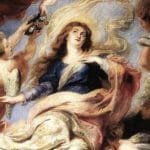
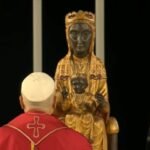
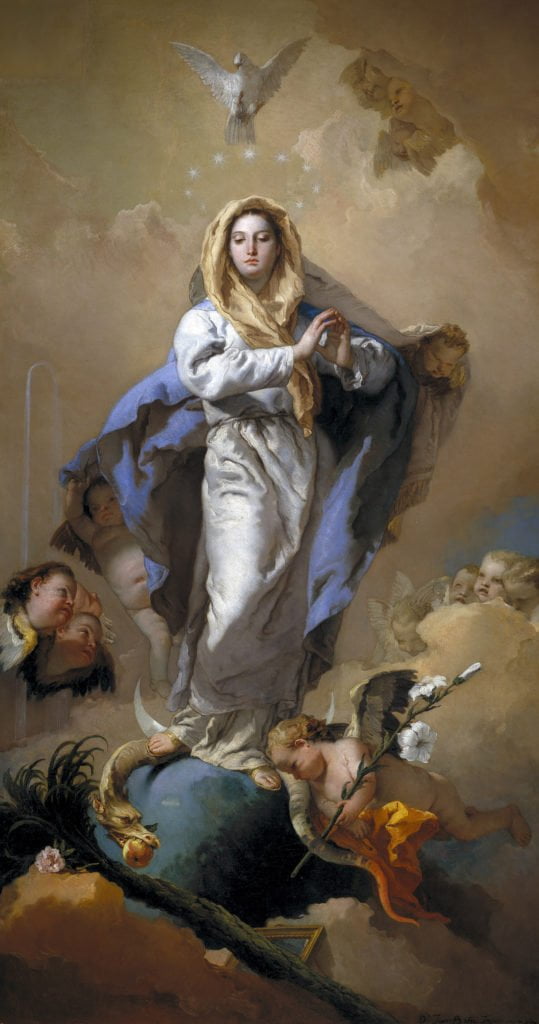
“Hail, full of grace” (Lk 1:28). With these words of greeting in the lowly house of Nazareth, the Angel revealed to Mary the mystery of her immaculate heart, “preserved free from all stain of original sin” from the moment of her conception (BL. PIUS IX, Ineffabilis Deus, 8 December 1854). In a variety of ways, down the centuries, Christians have sought to describe that gift in words and images, emphasizing the tenderness and grace of Our Lady, “blessed among all women” (cf. Lk 1:42) by portraying her with the native features and characteristics of any number of different peoples and cultures.
As Saint Paul VI observed, the Mother of God shows us “what all of us have deep in our hearts: the authentic image of humanity… innocent and holy… Mary’s being is pure harmony, candour, simplicity; it is complete transparency, kindness, perfection; it is utter beauty” (Homily on the Solemnity of the Immaculate Conception, 8 December 1963). Mary is pure harmony, candour and simplicity.
Let us pause for a moment to contemplate Mary’s beauty in the light of the Word of God, focusing on three aspects of her life that remind us of her closeness to us. What are these three aspects? Mary as daughter, bride and mother.
First, let us consider the Immaculate Virgin as daughter. Sacred Scripture does not speak of Mary’s childhood. The Gospel presents her to us as she enters upon the stage of history: a young girl of deep faith, humble and simple. Mary is the “virgin” (cf. Lk 1:27) whose gaze reflects the Father’s love. Within Mary’s pure heart, her gratuitous love and thankfulness give colour and fragrance to her holiness. Our Lady appears before us as a beautiful flower that grew unnoticed until it finally blossomed in the gift of self. Mary’s life is a continuous gift of self-giving.
This brings us to the second dimension of Mary’s beauty: that of a bride, chosen by God as a companion for his plan of salvation (cf. Lumen Gentium, 61). This is what the Council said: God chose Mary. He chose a woman as his helper to carry out the plan of salvation. There is no salvation without a woman since the Church herself is also woman. She responded “Yes” by saying, “Behold the handmaid of the Lord” (Lk 1:38). She is a “handmaid” not in the sense of being “servile” and “humiliated”, but in the sense that she was “trusted” and “esteemed” as one to whom the Lord entrusted his dearest treasures and the most important missions. Mary’s beauty, multifaceted like that of a diamond, reveals a new face: one of fidelity, loyalty and loving concern, all of which are typical of the mutual love of spouses. Saint John Paul II understood just this when he wrote that the Immaculate Virgin “accepted her election as Mother of the Son of God, guided by spousal love, the love which totally ‘consecrates’ a human being to God” (Redemptoris Mater, 39).
We now come to the third dimension of Mary’s beauty. What is this third dimension? Mary as mother. She is most often depicted as a mother with the Child Jesus in her arms or bending over the Son of God as he lay in the manger (cf. Lk 2:7). She was present beside her Son throughout his life, ever close in her maternal care yet hidden in her humility. We witness this closeness at Cana, where she interceded for the bride and groom (cf. Jn 2:3-5), at Capernaum, where she was praised for listening to the Word of God (cf. Lk 11:27-28) and finally at the foot of the cross – the mother of a condemned man –, where Jesus himself gave her to us as our mother (cf. Jn 19:25-27). There, at the foot of the cross, the Immaculate Virgin is beautiful in her fruitfulness, since she recognizes that she must die to herself in order to give life, forget herself in order to care for the poor and vulnerable who turn to her.
All these things are contained in Mary’s pure Heart, a heart that is free from sin, docile to the working of the Holy Spirit (cf. Redemptoris Mater, 13) and ready to offer to God, out of love, “the full submission of intellect and will” (Dei Verbum, 5; cf. Dei Filius, 3).
There is the risk, however, of thinking that Mary’s beauty is somehow remote, out of reach, unattainable. That is not the case. We too have received this beauty as a gift in Baptism, when we were freed from sin and became sons and daughters of God. Like the Virgin Mary, we are called to cultivate this beauty with a filial, spousal and maternal love. Like her, may we be grateful for what we have received and generous in what we give back. May we be men and women who are ready to say “Thank you” and “Yes”, not just with our words, but above all by our actions –it is a beautiful thing to find men and women who say “Thank you” and “Yes” through their actions – ever ready to make room for the Lord in our plans and aspirations, eager to embrace with maternal tenderness the brothers and sisters we encounter on our way. The Immaculate Virgin is not a myth, an abstract doctrine or an impossible ideal. She is the model of a beautiful and concrete project, the perfect example of our humanity. As we imitate her, may all of us, by God’s grace, help to change our world for the better.
Sadly, if we look around us, we realize that the presumption that we can be “like God” (cf. Gen 3:1-6), which led to the first sin, continues to wound our human family. Neither love nor happiness can arise from this presumption of self-sufficiency. Those who see the rejection of any stable and lasting bond in life as progress do not grant freedom. Those who deprive fathers and mothers of respect, those who do not want children, those who reduce others to mere objects or treat them as nuisances, those who consider sharing with others a waste, and solidarity an impoverishment, cannot spread joy or build a future. What is the use of having a full bank account, a comfortable home, unreal virtual relationships, if our hearts remain cold, empty and closed? What is the use of achieving great financial growth in privileged countries if half the world is starving or ravaged by war, and the others look on with indifference? What is the use of travelling around the world if every encounter is reduced to a passing impression or a photograph that no one will remember in a few days or months?
Brothers and sisters, let us look to Mary Immaculate and ask her to conquer us through her loving Heart. May she convert us and make us a community in which filial, spousal and maternal love may be a rule and criterion of life. Only then will families be united, will spouses truly share everything, will parents be physically present and close to their children and children will take care of their parents. That is the beauty we see in the Immaculate Virgin; that is the “beauty that saves the world”. Like Mary, we too want to respond by saying to the Lord: “Behold… Let it be to me according to your word” (Lk 1:38).
We are celebrating this Eucharist with the new Cardinals. I have asked them, my brothers, to help me in my pastoral service to the Universal Church. They have come from many parts of the world, bringing great wisdom, in order to contribute to the growth and spread of the Kingdom of God. Let us now entrust them in a special way to the intercession of the Mother of our Saviour.
Source: https://www.vatican.va/content/francesco/en/homilies/2024/documents/20241208-omelia-nuovi-cardinali.html
EMPHASIS MINE
Copyright © Dicastero per la Comunicazione – Libreria Editrice Vaticana
ANGELUS
Saint Peter’s Square
Friday, 8 December 2023
_____________________________
Dear brothers and sisters, buongiorno and happy feast day!
Today, the solemnity of the Immaculate Conception, the Gospel presents us with the scene of the Annunciation (cf. Lk 1:26-38). It demonstrates two of Mary’s attitudes that help us understand how she may have guarded the unique gift she received – a heart completely free from sin. These two attitudes are amazement regarding the works of God and fidelity in the simple things.
Let’s look at the first: amazement. The Angel says to Mary, “Rejoice, full of grace: the Lord is with you” (cf. v. 28). And the Evangelist Luke notes that the Virgin “was greatly troubled…and tried to discern what sort of greeting this might be” (v. 29). She remains surprised, struck, troubled: she is amazed when she hears herself called “full of grace” – Our Lady is humble – that is, filled with God’s love. This is a very noble attitude: to be amazed before the Lord’s gifts, never taking them for granted, appreciating their value, rejoicing in the trust and tenderness they bring with them. And it is also important to demonstrate this amazement before others, speaking humbly about God’s gifts, about the good received, and not only about daily problems. To be more positive. We can ask ourselves: Do I know how to be amazed regarding God’s works? Does it happen at times that I am filled with wonder and share it with someone? Or am I always focused on the bad things, sad things?
And now the second attitude: fidelity in simple things. Prior to the Annunciation, the Gospel says nothing about Mary. She is presented as a simple girl, apparently equal to so many others who were living in her village. A young girl who, precisely because of her simplicity, kept pure that Immaculate Heart with which, by God’s grace, she had been conceived. And this too is important, for to welcome God’s great gifts, it is necessary to know how to treasure those that are more everyday and less apparent.
It is precisely with her daily fidelity in goodness that Our Lady allowed God’s gift to grow within her. This is how she trained herself to respond to the Lord, to say “yes” to him with her entire life.
So, let us ask ourselves: Do I believe that fidelity to God is important both in everyday situations as well as in my spiritual journey? And if I believe this, do I find the time to read the Gospel, to pray, to participate in the Eucharist and to receive Sacramental forgiveness, to perform some tangible act of disinterested service? These are the small everyday choices, choices necessary to welcome the Lord’s presence.
May Mary Immaculate help us be amazed at God’s gifts and respond to them with faithful generosity each day.
Source and copyright: https://www.vatican.va/content/francesco/en/angelus/2023/documents/20231208-angelus.html
Pope Francis on the Solemnity of the Immaculate Conception of the Blessed Virgin Mary 2022
ANGELUS
Saint Peter’s Square
Thursday, 8 December 2022
_____________________________
Dear brothers and sisters, buongiorno and happy feast day!
The Gospel of today’s Solemnity introduces us into the home of Mary to recount the Annunciation (cf. Lk 1:26-38). The angel Gabriel greets the Virgin like this: “Hail, full of grace, the Lord is with you” (v. 28). He does not call her by her name, Mary, but with a new name, that she did not know: full of grace. Full of grace, and therefore free from sin, is the name God gives her and that we celebrate today.
But let us think of Mary’s wonder: only then did she discover her truest identity. Indeed, by calling her by that name, God reveals her greatest secret to her, which was previously unknown to her. Something similar can also happen to us. In what sense? In the sense that we sinners have also received an initial gift that has filled our lives, a good greater than anything else: we have received an original grace. We talk a lot about original sin, but we have also received an original grace, of which often we are unaware.
What is it, this original grace? It is what we received on the day of our Baptism, which is why it is good for us to remember, and even celebrate it! I will ask you a question: this grace received on the day of Baptism, it is important. But how many of you remember the date of your Baptism, what is the date of your own Baptism? Think about it. And if you do not remember, when you go home, ask your godfather, your godmother, your father or mother: “When was I baptized?”, because that day is the day of the great grace, of a new life beginning, of an original grace that we have. God descended into our lives that day, and we became his beloved children forever. This is our original beauty, for which to be joyful! Today, Mary, surprised by the grace that made her beautiful from the first instant of her life, leads us to marvel at our beauty. We can grasp this through the image of the white Baptismal garment; it reminds us that, beyond the evil we have stained ourselves with over the years, there is a good in us greater than all the evils that have befallen. Let us listen to the echo, let us hear God saying to us: “Son, daughter, I love you and I am with you always, you are important to me, your life is precious”. That is God’s message to us. When things do not go well and we are discouraged, when we are downcast and risk feeling useless or wrong, let us think about this, about this original grace. And God is with us, God is with me from that day. Let us think about it again.
Today the Word of God teaches us another important thing: that to safeguard our beauty demands a cost, it demands a struggle. Indeed, the Gospel shows us the courage of Mary who said “Yes” to God, who chose the risk of God; and the passage from Genesis, on original sin, speaks to us of a battle against the tempter and his temptations (cf. Gen 3:15). But we know this from experience too, all of us: it takes effort to choose good, it costs us; it takes effort to safeguard the good that is in us. Think of how many times we have squandered it by giving in to the lure of evil, being crafty for our own interests or doing something that would defile our hearts; or even wasting time in useless or harmful things, putting off prayer, for example, and saying “Today I can’t”, or saying “I can’t” to those who have needed us, when instead we could have.
But today, faced with all this, we have good news: Mary, the only human being in history without sin, is with us in the battle, she is our sister and, above all, our Mother. And we, who struggle to choose good, can entrust ourselves to her.By entrusting ourselves, consecrating ourselves to Mary, we say to her: “Take me by the hand, Mother, guide me: with you I will have more strength in the battle against evil; with you I will rediscover my original beauty”. Let us entrust ourselves to Mary today, let us entrust ourselves to Mary every day, repeating to her: “Mary, I entrust my life to you, I entrust my family, my work, I entrust my heart and my struggles. I consecrate myself to you”. May Mary Immaculate help us to safeguard our beauty from evil.
Source: https://www.vatican.va/content/francesco/en/angelus/2022/documents/20221208-angelus.html
Emphasis mine.
Pope Francis on the Solemnity of the Immaculate Conception of the Blessed Virgin Mary 2021
_________________________________
Dear brothers and sisters, buongiorno!
The Gospel for today’s Liturgy, the Solemnity of the Immaculate Conception of the Blessed Virgin Mary, brings us into the house of Nazareth, where she receives the angel’s annunciation (cf. Lk 1:26-38). Within the domestic walls, a person reveals him or herself better than elsewhere. And it is precisely within that domestic intimacy that the Gospel gives us a detail that reveals the beauty of Mary’s heart.
The angel calls her “full of grace”. If she is full of grace, it means the Madonna is void of evil: she is without sin, Immaculate. Now, at the angel’s greeting, Mary – the text says – is “greatly troubled” (Lk 1:29). She is not only surprised, but troubled. To receive grand greetings, honours and compliments sometimes brings the risk of provoking pride and presumption. Let us recall that Jesus is not gentle with those who go in search of greetings in the squares, adulation, visibility (cf. Lk 20:46). Mary, instead, does not exalt herself, but is troubled; rather than feeling pleased, she feels amazement. The angel’s greeting seemed too grand for her. Why? Because she feels her littleness within, and that littleness, that humility attracts God’s eyes.
Within the walls of the house of Nazareth, we thus see a marvellous characteristic of Mary’s heart. How is Mary’s heart? Having received the highest of compliments, she is troubled she because she hears addressed to her what she has not attributed to herself. In fact, Mary does not credit prerogatives to herself, she does not hold claim to anything, she accounts nothing to her own merit. She is not self-satisfied, she does not exalt herself. For in her humility, she knows she receives everything from God. Therefore, free from herself, she is completely directed toward God and others. Mary Immaculate does not look on herself. This is true humility: not looking on oneself, but looking toward God and others.
Let us remember that this perfection of Mary, the full of grace, is declared by the angel within the walls of her house – not in Nazareth’s main square, but there, in hiding, in the greatest humility. In that little house of Nazareth beat the greatest heart that any creature has ever had. Dear brothers and sisters, this is extraordinary news for us! Because the Lord is telling us that to work marvellous deeds, he has no need of grand means and our lofty abilities, but our humility, eyes open to Him, and also open to others. With this annunciation, within the poor walls of a small house, God changed history. Even today, he wants to do great things with us in our daily lives: in our families, at work, in everyday environments. God’s grace loves to operate there more than in great historical events. But, I ask myself, do we believe this? Or rather do we think that holiness is a utopia, something for insiders, a pious illusion incompatible with ordinary life?
Let us ask the Madonna for a grace: that she free us from the misleading idea that the Gospel is one thing and life is another; that she enkindle enthusiasm in us for the ideal of sanctity which has nothing to do with holy cards and pictures, but is about living humbly and joyfully, like the Madonna, what happens each day, freed from ourselves, with our eyes fixed on God and the neighbour we meet. Let’s not lose heart: The Lord has given everyone the stuff it takes to weave holiness within our everyday life! And when we are assailed by the doubt that we cannot succeed, the sadness of not being adequate, let us allow the Madonna to look on us with her “eyes of mercy”, for no one who asked for her help has ever been abandoned!
______________________________________
Copyright © Dicastero per la Comunicazione – Libreria Editrice Vaticana
SOURCE: https://www.vatican.va/content/francesco/en/angelus/2021/documents/papa-francesco_angelus_20211208.html
EMPHASIS MINE.
ANGELUS ADDRESS
Dec. 8, 2020
“Chosen to be holy and immaculate before the foundation of the world”
Dear Brothers and Sisters, good afternoon!
Today’s liturgical feast celebrates one of the wonders of the story of salvation: the Immaculate Conception of the Virgin Mary. Even she was saved by Christ, but in an extraordinary way, because God wanted that the mother of His Son not be touched by the misery of sin from the moment of her conception. And so, for the entire course of her earthly life, Mary was free from any stain of sin, she was the “full of grace” (Lk 1:28), as the angel called her. She was favoured by a singular action of the Holy Spirit so as to always remain in perfect relationship with her Son, Jesus. Rather, she was Jesus’s disciple: His Mother and disciple. But there was no sin in her.
In the magnificent hymn that opens the Letter to the Ephesians (see 1:3-6, 11-12), St Paul makes us understand that every human being is created by God for that fullness of holiness, for that beauty of which the Madonna was clothed from the beginning. The goal to which we are called is also a gift of God for us, for which, the Apostles says He “chose us before the foundation of the world, to be holy and without blemish” (v. 4); He predestined us (see v. 5), in Christ to be totally free from sin one day. And this is grace, it is gratuitous, it is a gift of God.
And what Mary had from the beginning, will be ours in the end, after we have passed through the purifying “bath” of God’s grace. What opens the gates of paradise to us is God’s grace, received by us with faithfulness. Even the most innocent were, nevertheless, marked by original sin and fought with all their strength against its consequences. They passed through the “narrow door” that leads to life (see Lk 13:24). And do you know who is the first person we are sure entered paradise? Do you know who? A “ruffian”: one of the two who was crucified with Jesus. And he turned to Jesus saying: “Jesus, remember me when you come into your kingdom”. And He responded: “Today you will be with me in paradise” (Lk 23:42-43). Brothers and sisters, God’s grace is offered to everyone; and many who are the least on this earth will be the first in heaven (see Mk 10:31).
But be careful. It does not pay to be clever – to continually postpone a serious evaluation of one’s own life, taking advantage of the Lord’s patience. He is patient. He waits for us, He is always ready to give us grace. We may be able to deceive people, but not God; He knows our hearts better than we ourselves do. Let us take advantage of the present moment! This, yes, is the Christian sense of seizing the day. To not enjoy life in each passing moment – no, this is the worldly sense. But to seize today, to say “no” to evil and “yes” to God, to open oneself to His grace, to once and for all stop thinking of ourselves, dragging ourselves into hypocrisy and to face our own reality as we are –this is who we are – to recognize that we have not loved God and neighbour as we should have. And to confess it, this is the beginning of a journey of conversion, asking God’s pardon first of all in the Sacrament of Reconciliation, and then to repair the harm done to others. But always open to grace: the Lord knocks on our door, He knocks on our heart to enter into friendship with us, in communion, to give us salvation.
And this, for us, is the path for becoming “holy and immaculate”. The uncontaminated beauty of our Mother is incomparable, but at the same time it attracts us. Let us entrust ourselves to her and say “no” to sin and “yes” to Grace once and for all.
SOURCE: http://www.vatican.va/content/francesco/en/angelus/2020/documents/papa-francesco_angelus_20201208.html
EMPHASIS MINE.
ANGELUS ADDRESS DEC. 8, 2019
Mary’s “yes”
Good Morning!
Today we celebrate the solemnity of Mary Immaculate, which takes place within the context of Advent, a time of expectation: God will accomplish what he promised. But on today’s feast day we are told that something has already been accomplished, in the person and the life of the Virgin Mary. Today we consider the beginning of this fulfilment, which is even before the birth of the Mother of the Lord. In fact, her immaculate conception leads us to that precise moment when Mary’s life began to palpitate in her mother’s womb: already there was the sanctifying love of God, preserving her from the contagion of evil that is the common inheritance of the human family.
In today’s Gospel the Angel’s greeting to Mary resounds: “Hail, full of grace, the Lord is with you!” (Lk 1:28). God has always thought of her and wanted her in his inscrutable plan, to be a creature full of grace, that is, full of his love. Yet, in order to be filled it is necessary to make room, to empty oneself, to step aside. Just as Mary did, she who knew how to listen to the Word of God and trust totally in his will, accepting it unreservedly in her own life. So much so that the Word became flesh in her. This was possible thanks to her “yes”. To the Angel who asks her to be ready to become the mother of Jesus, Mary replies: “Behold, I am the handmaid of the Lord; let it be to me according to your word” (v. 38).
Mary does not lose herself in reasoning, she does not place obstacles in the Lord’s way, but she promptly entrusts herself and makes room for the action of the Holy Spirit. She immediately makes her whole being and her personal history available to God, so that the Word and the will of God may shape and bring them to fulfilment. Perfectly corresponding to God’s plan for her, Mary then becomes the “all beautiful”, the “all holy”, but without the slightest shadow of complacency. She is humble. She is a masterpiece, whilst remaining humble, small, poor. In her is reflected the beauty of God which is all love, grace, gift of self.
I would also like to underline the word with which Mary defines herself in her surrender to God: she professes herself “the handmaid of the Lord”. Mary’s “yes” to God takes on from the beginning the attitude of service, of attention to the needs of others. The visit to Elizabeth which immediately follows the Annunciation testifies this concretely. One’s availability to God is found in one’s willingness to take on the needs of one’s neighbour. All of this without clamour and ostentation, without seeking places of honour, without advertising, because charity and works of mercy needn’t be exhibited as a trophy. Works of mercy are done in silence, in secrecy, without boasting of doing them. Even in our communities, we are called to follow the example of Mary, practicing the style of discretion and concealment.
May the feast of our Mother help us to make our whole life a “yes” to God, a “yes” made of adoration of him and of daily gestures of love and service.
SOURCE: http://www.vatican.va/content/francesco/en/angelus/2019/documents/papa-francesco_angelus_20191208.html
EMPHASIS MINE.
ANGELUS ADDRESS, DEC. 8, 2018
“Here I am.”
Dear Brothers and Sisters, Good morning and happy Feast Day!
Today the Word of God presents us with an alternative. In the first reading there is the man who, at the origin, says no to God, and in the Gospel there is Mary who, at the Annunciation, says yes to God. In both readings it is God who seeks mankind. But in the first case God goes to Adam, after the sin, and asks him: “Where are you?” (Gen 3:9), and Adam responds: “I hid myself” (v. 10). In the second case, however, God goes to Mary, without sin, who responds: “Behold, I am the handmaid of the Lord” (Lk 1:38). Here I am is the opposite of I hid myself. Here I am opens one to God, while sin closes, isolates, causes one to be alone with oneself.
Here I am is the key phrase for life. It marks the passage from a horizontal life, centred on oneself and one’s own needs, to a vertical life, ascending toward God. Here I am is being available to the Lord; it is the cure for selfishness, the antidote to a dissatisfied life, which is always lacking something. Here I am is the remedy against the aging of sin; it is the therapy for staying young within. Here I am is believing that God counts more than my ‘me’. It is choosing to bet on the Lord, docile to his surprises. This is why saying here I am to him is the highest praise we can offer him. Why not begin our days with a ‘here I am, Lord’? It would be beautiful to say each morning: “Here I am, Lord, today let your will be done in me”. We will say it in praying the Angelus, but we can repeat it now, together. Here I am, Lord, today let your will be done in me!
Mary adds: “Let it be to me according to your word”. She does not say “let it be done as I want”, but “as You will”. She does not place any limitations on God. She does not think: “I will dedicate myself partly to him, I will deal with it and then I will do what I want”. No, Mary does not love the Lord when she feels like it, off and on. She lives by entrusting herself to God in all things and for all things. This is the secret of life. One who trusts God in everything can do everything. However, the Lord, dear brothers and sisters, suffers when we respond to him as Adam did: “I was afraid, and I hid myself”. God is Father, the most tender of fathers, and desires his children’s trust.
How often, instead, do we mistrust him; we mistrust God! We think that he might send us some trial, deprive us of freedom, abandon us. But this is a great mistake; it is the temptation of the origins, the temptation of the devil: weaving mistrust in God. Mary overcomes this first temptation with her here I am. And today we look at the beauty of Our Lady, born and lived without sin, ever docile and transparent to God.
This does not mean that life was easy for her, no. Being with God does not magically resolve problems. The conclusion of today’s Gospel passage recalls it: “the angel departed from her” (v. 38). He departed: it is a strong verb. The Angel left the Virgin alone in a difficult situation. She knew the special way in which she would become the Mother of God — the Angel had said so — but the Angel had not explained it to others, only to her. And problems began immediately: let us imagine the irregular situation according to law, to Saint Joseph’s torment, the life plan tossed aside, what the people would have said…. But faced with problems, Mary places her trust in God. She is left by the Angel, but believes that God remains with her, in her. And she trusts. She trusts in God. She is certain that with the Lord, even if in an unexpected way, everything will be fine. This is the wise approach: not to live depending on problems — when one ends, another appears! — but by trusting God and entrusting every day to him: here I am! “Here I am” is the phrase. “Here I am” is the prayer. Let us ask the Immaculate for the grace to live this way.
SOURCE: http://www.vatican.va/content/francesco/en/angelus/2018/documents/papa-francesco_angelus_20181208.html
EMPHASIS MINE.
ANGELUS ADDRESS, DEC. 8. 2017
“Full of grace”
Dear Brothers and Sisters, Good morning and happy Feast Day!
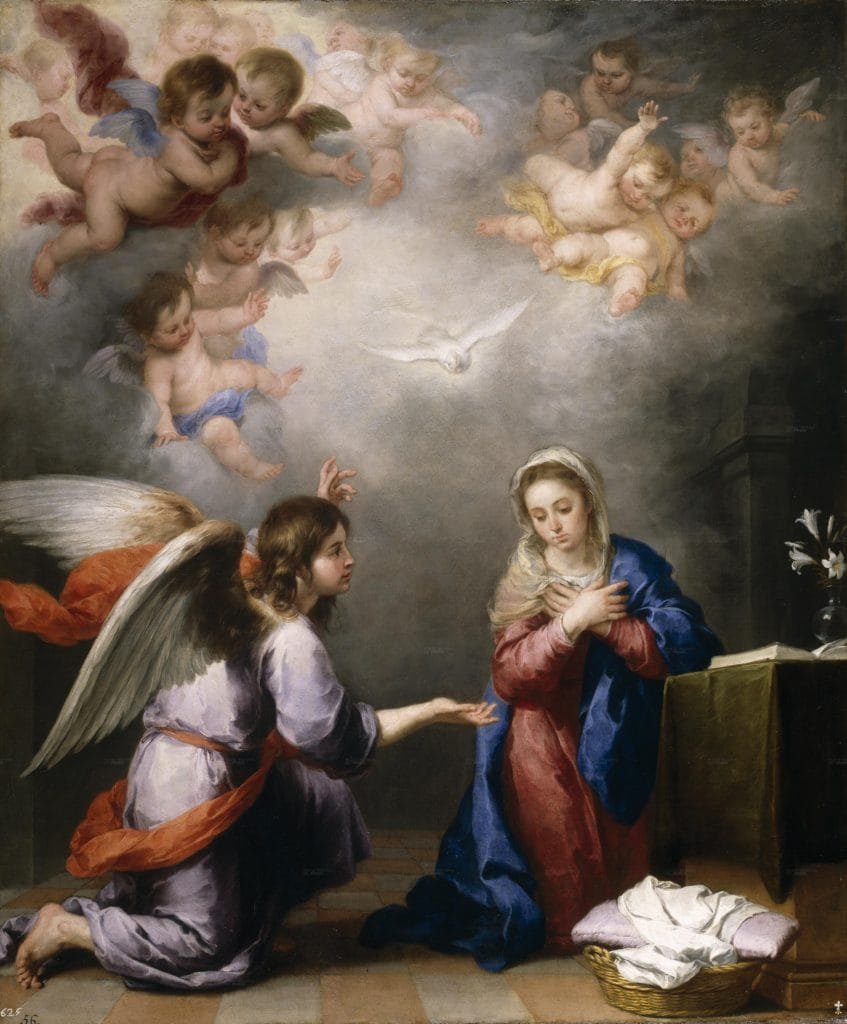
Today we are contemplating the beauty of Mary Immaculate. The Gospel, which recounts the episode of the Annunciation, helps us to understand what we are celebrating, above all through the Angel’s greeting. He addresses Mary with a word that is not easy to translate, which means “filled with grace”, “created by grace”, “full of grace” (Lk 1:28). Before calling her ‘Mary’, he calls her full of grace, and thus reveals the new name that God has given her and which is more becoming to her than the name given to her by her parents. We too call her in this way, with each Hail Mary.
What does full of grace mean? That Mary is filled with the presence of God. And if she is entirely inhabited by God, there is no room within her for sin. It is an extraordinary thing, because everything in the world, regrettably, is contaminated by evil. Each of us, looking within ourselves, sees dark sides. Even the greatest saints were sinners and everything in reality, even the most beautiful things, are corroded by evil: everything, except Mary. She is the one “evergreen oasis” of humanity, the only one uncontaminated, created immaculate so as to fully welcome, with her ‘yes’, God who came into the world and thus to begin a new history.
Each time we acknowledge her as full of grace, we give her the greatest compliment, the same one God had given her. A beautiful compliment to give to a woman and to tell her, politely, that she looks youthful. When we say full of grace to Mary, in a certain sense we are telling her this too, at the highest level. In fact we recognize her as forever youthful, because she never aged through sin. There is only one thing that makes us age, grow old interiorly: not age, but sin. Sin ages, because it hardens the heart. It closes it, renders it inert, withers it. But she, full of grace, is without sin. So she is always youthful; she is “younger than sin” and is “the youngest of humankind” (G. Bernanos, Diario di un curato di campagna, ii, 1988, p. 175).
The Church today compliments herself with Mary by calling her ‘all fair’, tota pulchra. Just as her youth does not lie in age, her beauty does not consist in her outward appearance. Mary, as today’s Gospel reading shows us, does not stand out in appearance: from a simple family, she lived humbly in Nazareth, a village practically unknown. And she wasn’t well-known: even when the Angel visited her, no one knew of it; there were no reporters there that day. Nor did Our Lady have a comfortable life, but worries and fears: she was “greatly troubled” (v. 29), the Gospel says, and when the Angel “departed from her” (v. 38), her troubles mounted.
However, she, full of grace, lived a beautiful life. What was her secret? We can understand it by looking again at the scene of the Annunciation. In many paintings Mary is depicted as seated before the Angel with a small book in her hand. This book is the Scripture. Thus, Mary was accustomed to listening to God and interacting with him. The Word of God was her secret: close to her heart, it then became flesh in her womb.By dwelling with God, in dialogue with him in every circumstance, Mary made her life beautiful. Not appearances, not what is fleeting, but the heart directed toward God makes life beautiful. Today let us look joyfully at her, full of grace. Let us ask her to help us to remain youthful, by saying ‘no’ to sin, and to live a beautiful life, by saying ‘yes’ to God.
SOURCE: http://www.vatican.va/content/francesco/en/angelus/2017/documents/papa-francesco_angelus_20171208.html
EMPHASIS MINE.
ANGELUS ADDRESS DEC. 8, 2016
Mary’s total “yes” to God.
Dear Brothers and Sisters, Happy feast day!
The readings for today’s Solemnity of the Immaculate Conception of the Blessed Virgin Mary present two crucial passages in the history of the relationship between man and God: we could say that they lead us towards the origin of good and evil. These two passages lead us to the origin of good and evil.
The second crucial passage, recounted today in the Gospel, is when God comes to live among us, becomes man like us. And this was made possible through a great ‘yes’ – that of the sin was the ‘no’; this is the ‘yes’, it is a great ‘yes’ — that of Mary at the moment of the Annunciation. Because of this ‘yes’ Jesus began his journey along the path of humanity; he began it in Mary, spending the first months of life in his mother’s womb: he did not appear as a man, grown and strong, but he followed the journey of a human being. He was made equal to us in every way, except one thing, that ‘no’. Except sin. For this reason, he chose Mary, the only creature without sin, immaculate. In the Gospel, with one word only, she is called “full of grace” (Lk 1:28), that is, filled with grace. It means that, in her, full of grace from the start, there is no space for sin. And when we turn to her, we too recognize this beauty: we invoke her, “full of grace”, without a shadow of evil.
For each of us too, there is a history of salvation made up of ‘yeses’ and ‘nos’. Sometimes, though, we are experts in the half-hearted ‘yes’: we are good at pretending not to understand what God wants and what our conscience suggests. We are also crafty and so as not to say a true ‘no’ to God, we say: “Sorry, I can’t”; “not today, I think tomorrow”. “Tomorrow I’ll be better; tomorrow I will pray, I will do good tomorrow”. And this cunning leads us away from the ‘yes’. It distances us from God and leads us to ‘no’, to the sinful ‘no’, to the ‘no’ of mediocrity. The famous “yes, but …”; “yes, Lord, but …”. In this way we close the door to goodness, and evil takes advantage of these omitted ‘yeses’. Each of us has a collection of them within. Think about it: we will find many omitted ‘yeses’. Instead, every complete ‘yes’ to God gives rise to a new story: to say ‘yes’ to God is truly “original”. It is the origin, not the sin, that makes us old on the inside. Have you thought about this, that sin makes us old on the inside? It makes us grow old quickly”! Every ‘yes’ to God gives rise to stories of salvation for us and for others. Like Mary with her own ‘yes’. In this Advent journey, God wishes to visit us and awaits our ‘yes’. Let’s think: I, today, what ‘yes’ must I say to God? Let’s think about it; it will do us good. And we will find the Lord’s voice in God, who asks something of us: a step forward. “I believe in you; I hope in you. I love you; be it done to me according to your good will”. This is the ‘yes’. With generosity and trust, like Mary, let us say today, each of us, this personal ‘yes’ to God.
SOURCE: https://w2.vatican.va/content/francesco/en/angelus/2016/documents/papa-francesco_angelus_20161208.html
EMPHASIS MINE.
HOMILY
8 December 2015
Dear Brothers and Sisters,
In a few moments I will have the joy of opening the Holy Door of Mercy. We carry out this act, so simple yet so highly symbolic, in the light of the word of God which we have just heard. That word highlights the primacy of grace. Again and again these readings make us think of the words by which the angel Gabriel told an astonished young girl of the mystery which was about to enfold her: “Hail, full of grace” (Lk 1:28).
The Virgin Mary was called to rejoice above all because of what the Lord accomplished in her. God’s grace enfolded her and made her worthy of becoming the Mother of Christ. When Gabriel entered her home, even the most profound and impenetrable of mysteries became for her a cause for joy, faith and abandonment to the message revealed to her. The fullness of grace can transform the human heart and enable it to do something so great as to change the course of human history.
This Extraordinary Holy Year is itself a gift of grace. To pass through the Holy Door means to rediscover the infinite mercy of the Father who welcomes everyone and goes out personally to encounter each of them. This will be a year in which we grow ever more convinced of God’s mercy. How much wrong we do to God and his grace when we speak of sins being punished by his judgment before we speak of their being forgiven by his mercy (cf. Saint Augustine, De Praedestinatione Sanctorum, 12, 24)! But that is the truth. We have to put mercy before judgment, and in any event God’s judgement will always be in the light of his mercy. In passing through the Holy Door, then, may we feel that we ourselves are part of this mystery of love. Let us set aside all fear and dread, for these do not befit men and women who are loved. Instead, let us experience the joy of encountering that grace which transforms all things.
HOMILY SOURCE: http://en.radiovaticana.va/news/2015/12/08/pope_francis_homily_for_inauguration_of_the_jubilee/1192758 (Bold letters mine to highlight important ideas)
Stay updated: subscribe by email for free TO OUR NEW WEBSITE www.catholicsstrivingforholiness.org (PUT YOUR EMAIL IN THE SUBSCRIBE WIDGET).
We are also in www.fb.com/Catholicsstrivingforholiness. Kindly help more people in their Christian life by liking our page and inviting your family, friends and relatives to do so as well. Thanks in advance and God bless you and your loved ones! Fr. Rolly Arjonillo