POPE FRANCIS’ 2020 CHRISTMAS MIDNIGHT MASS HOMILY Dec. 24, 2020
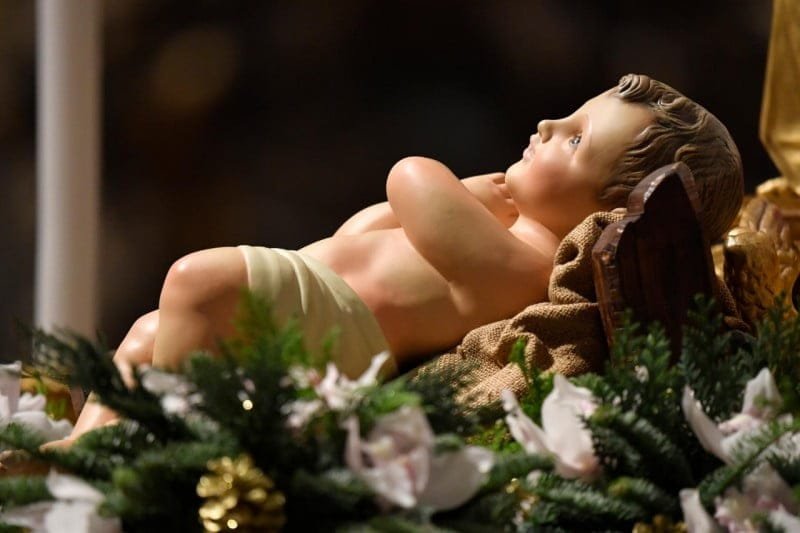
Below you have the official Vatican translation of Pope Francis’ Christmas 2020 Homily during the Midnight Mass.
Tonight, the great prophecy of Isaiah is fulfilled: “For to us a child is born, to us a son is given” (Is 9:6).
To us a son is given. We often hear it said that the greatest joy in life is the birth of a child. It is something extraordinary and it changes everything. It brings an excitement that makes us think nothing of weariness, discomfort, and sleepless nights, for it fills us with indescribable and incomparable happiness. That is what Christmas is: the birth of Jesus is the “newness” that enables us to be reborn each year and to find, in him, the strength needed to face every trial. Why? Because his birth is for us – for me, for you, for everyone. “For” is a word that appears again and again on this holy night: “For us a child is born”, Isaiah prophesied. “For us is born this day a Saviour”, we repeated in the Psalm. Jesus “gave himself for us” (Tit 2:14), Saint Paul tells us, and in the Gospel, the angel proclaims: “For to you is born this day a Saviour” (Lk 2:11).
Yet what do those words – for us – really mean? They mean that the Son of God, the one who is holy by nature, came to make us, as God’s children, holy by grace. Yes, God came into the world as a child to make us children of God. What a magnificent gift! This day, God amazes us and says to each of us: “You are amazing”. Dear sister, dear brother, never be discouraged. Are you tempted to feel you were a mistake? God tells you, “No, you are my child!” Do you have a feeling of failure or inadequacy, the fear that you will never emerge from the dark tunnel of trial? God says to you, “Have courage, I am with you”. He does this not in words, but by making himself a child with you and for you. In this way, he reminds you that the starting point of all rebirth is the recognition that we are children of God. This is the undying heart of our hope, the incandescent core that gives warmth and meaning to our life. Underlying all our strengths and weaknesses, stronger than all our past hurts and failures, or our fears and concerns about the future, there is this great truth: we are beloved sons and daughters. God’s love for us does not, and never will, depend upon us. It is completely free love, pure grace. Tonight, Saint Paul tells us, “the grace of God has appeared” (Tit 2:11). Nothing is more precious than this.
To us a son is given. The Father did not give us a thing, an object; he gave his own only- begotten Son, who is all his joy. Yet if we look at our ingratitude towards God and our injustice towards so many of our brothers and sisters, a doubt can arise. Was the Lord right in giving us so much? Is he right still to trust us? Does he not overestimate us? Of course, he overestimates us, and he does this because he is madly in love with us. He cannot help but love us. That is the way he is, so different from ourselves. God always loves us with a greater love than we have for ourselves. This is his secret for entering our hearts. God knows that we become better only by accepting his unfailing love, an unchanging love that changes us. Only the love of Jesus can transform our life, heal our deepest hurts, and set us free from the vicious circles of disappointment, anger, and constant complaint.
To us a son is given. In the lowly manger of a darkened stable, the Son of God is truly present. But this raises yet another question. Why was he born at night, without decent accommodation, in poverty and rejection, when he deserved to be born as the greatest of kings in the finest of palaces? Why? To make us understand the immensity of his love for our human condition: even to touching the depths of our poverty with his concrete love. The Son of God was born an outcast, in order to tell us that every outcast is a child of God. He came into the world as each child comes into the world, weak and vulnerable so that we can learn to accept our weaknesses with tender love. And to discover something important. As he did in Bethlehem, so too with us, God loves to work wonders through our poverty. He placed the whole of our salvation in the manger of a stable. He is unafraid of our poverty, so let us allow his mercy to transform it completely!
This is what it means to say that a son is born for us. Yet we hear that word “for” in another place, too. The angel proclaims to the shepherds: “This will be a sign for you: a baby lying in a manger” (Lk 2:12). That sign, the Child in the manger, is also a sign for us, to guide us through life. In Bethlehem, a name that means “House of Bread”, God lies in a manger, as if to remind us that, in order to live, we need him, like the bread we eat. We need to be filled with his free, unfailing, and concrete love. How often instead, in our hunger for entertainment, success, and worldly pleasures, do we nourish life with food that does not satisfy and leaves us empty within! The Lord, through the prophet Isaiah, complained that, while the ox and the donkey know their master’s crib, we, his people, do not know him, the source of our life (cf. Is 1:2-3). It is true: in our endless desire for possessions, we run after any number of mangers filled with ephemeral things and forget the manger of Bethlehem. That manger, poor in everything yet rich in love, teaches that true nourishment in life comes from letting ourselves be loved by God and loving others in turn. Jesus gives us the example. He, the Word of God, becomes an infant; he does not say a word but offers life. We, on the other hand, are full of words, but often have so little to say about goodness.
To us a son is given. Parents of little children know how much love and patience they require. We have to feed them, look after them, bathe them, and care for their vulnerability and their needs, which are often difficult to understand. A child makes us feel loved but can also teach us how to love. God was born a child in order to encourage us to care for others. His quiet tears make us realize the uselessness of our many impatient outbursts. His disarming love reminds us that our time is not to be spent in feeling sorry for ourselves, but in comforting the tears of the suffering. God came among us in poverty and need, to tell us that in serving the poor, we will show our love for him. From this night onward, as a poet wrote, “God’s residence is next to mine, his furniture is love” (EMILY DICKINSON, Poems, XVII).
To us a son is given. Jesus, you are the Child who makes me a child. You love me as I am, not as I imagine myself to be. In embracing you, the Child of the manger, I once more embrace my life. In welcoming you, the Bread of life, I too desire to give my life. You, my Saviour, teach me to serve. You who did not leave me alone, help me to comfort your brothers and sisters, for, from this night forward, all are my brothers and sisters.[01609-EN.01] [Original text: Italian]
© Libreria Editrice Vatican