APOSTOLIC JOURNEY OF HIS HOLINESS POPE LEO XIV
TO SPAIN
(6-12 JUNE 2026)
HOLY MASS, PROCESSION AND EUCHARISTIC BLESSING
IN THE SOLEMNITY OF THE BODY AND BLOOD OF CHRIST
HOMILY OF THE HOLY FATHER
“Plaza de Cibeles” (Madrid)
Sunday, 7 June 2026
Cycle A
_______________________________
Your Eminences and Your Excellencies,
Dear priests, men, women religious,
Your Majesties,
Dear brothers and sisters,
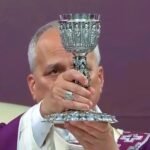
As I begin my visit to Spain, it is with a heart filled with joy that I preside over this celebration on the Solemnity of Corpus Christi.
We are gathered around the Eucharist, the gift of Christ’s living presence among us.He who wished to offer us his life so that we might enter into communion with the Father and become his children, is here as the living Bread come down from heaven, to nourish us with the very life of God, with a love stronger than death.
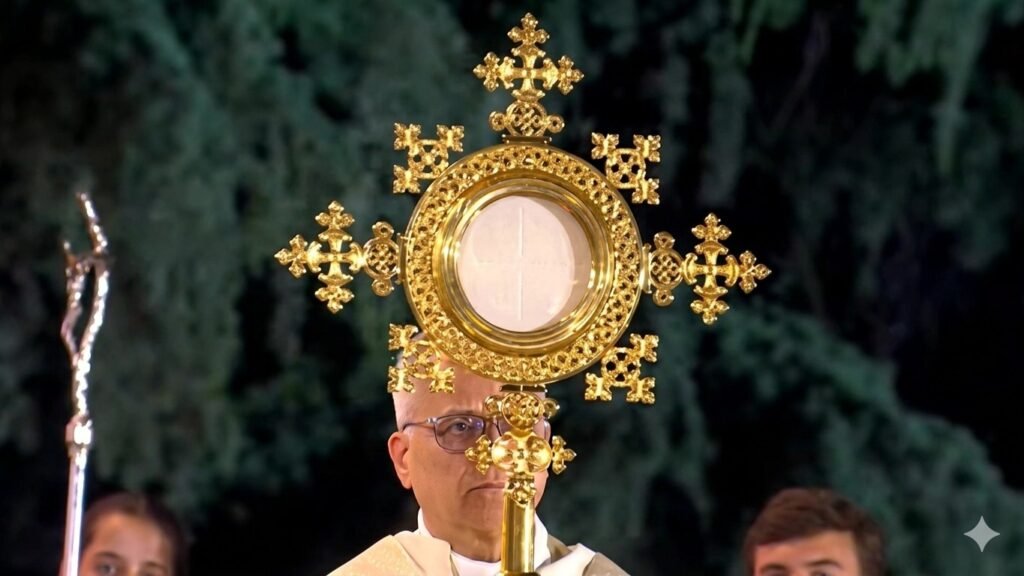
This awareness of the Lord’s presence in the Eucharistic Bread is deeply rooted in the faith and the history of your people. Here in Madrid, as in many other parts of Spain, Corpus Christi is more than just another celebration on the liturgical calendar. It is a way of returning to the heart of the faith to renew our love and fidelity to God. The solemn processions held on this day have for centuries shaped the piety, art, music, architecture and life of the Spanish people. Even today, they still express and manifest the spiritual sentiments of this country through the beauty and elegance of the floral carpets, the altars erected in the streets, the carefully crafted monstrances and stands, the hymns and the liturgical vestments. This is not an exhibition, a remnant of folklore or a simple display of beauty. It is a profession of faith in the presence of the risen Lord, who is alive and continues to walk among us, who becomes bread to satiate our hunger for life, and visits the recesses of our hearts and history, even those shrouded in darkness.
Just as Christ gives himself as food in the Eucharistic celebration, the procession shows that he is not confined to the church, but comes out to meet us. Jesus travels the streets, crosses the squares and visits our neighborhoods, dwelling in the settings of our daily lives. He is a God who is close to us, who walks with his people, the Lord of history. He is comfort to the weak, light for families, hope for the sick and peace for those who suffer. The Christ who processes through the streets in the monstrance is the same one who identifies with the poor, the downtrodden, those who are alone and forsaken. It is no coincidence that the Church here in Spain has long combined the Solemnity of Corpus Christi with the Day for Charity.
It is not merely a matter of bringing out the monstrance, but of allowing ourselves to be brought out of our selfishness and indifference, of a comfortable, private faith, so as to respond to his invitation to conversion, to change our perspective, and to welcome his presence which transforms us and makes us builders of a new world.
For this reason, the historical memory of the Corpus Christi processions is not confined to wistful nostalgia. Instead, it stands as an invitation in the present moment, in our daily lives, in our relationships, in society, and in the building of the future. It is in this context that we must understand the invitation to “remember” that we heard in the first reading: “Remember the long way that the Lord your God has led you these forty years in the wilderness” (Deut 8:3); remember how he fed you with manna when you were hungry. We must “remember” precisely so as not to forget who the Lord is, so as not to fall into the temptation of trusting in other idols and feeding on bread that does not satisfy.
Herein lies the task of Spain today and in the future: to ensure that the religiosity which has shaped and defined this country for centuries is not a museum of the past to be visited, but a school of faith from which to draw even today: A school that teaches us to kneel before God and before our neighbor, because no one can kneel before the Lord and despise their brother; A school that teaches us of the gratitude of love that becomes a gift, so that it may flow among us and break the chains of all selfishness; A school from which we learn that God is a real presence and that we too are called to be present in the realities and challenges of society, not shying away, but personally committing ourselves to the building of the common good.
Brothers and sisters, I wish to recall Saint Manuel González, the bishop of the abandoned tabernacle. His life reminds us that the Eucharist should be honored not only during great celebrations or on special occasions, but also through the silent fidelity of those who accompany the Lord with a humble and quiet friendship that is nourished day by day. I would also like to bring to mind the poetic verses of Saint John of the Cross: “For I know well the spring that flows and runs, although it is night” (Song of the Soul that Rejoices in Knowing God through Faith). While imprisoned in harsh conditions in the convent prison of Toledo, precisely around the time of Corpus Christi in 1578, he recognized the hidden presence of the Lord in the darkness of his cell, a presence from which emanates a light that never fades and flows a life that never diminishes. The Eucharistic Jesus is “that eternal spring that is hidden” — a spring that flows and quenches thirst, yet without blinding, without imposing itself through outward power, without presenting itself in a spectacular way (cf. ibid.).
Let us return to him with sincere love. Let us open ourselves to the encounter with him, let us allow him to quench the thirst of our hearts, so that we may then go forth into the paths of life and history, bringing to the people this stream of fresh water, a stream of love, peace, justice and joy. Let us drink anew from this Eucharistic spring, which does not enclose us in private devotion, but sends us out to refresh our brothers and sisters, our families, the poor, the suffering, and those who have lost hope. Eucharistic grace transforms us and makes us protagonists of the transformation of history, a sign of hope for those we meet.
May the Lord Jesus, present in the Eucharist, transform you into bread that is broken, given, and offered, so that a life of fullness may spring forth for you, for your families, and for your country.
Copyright © Dicastery for Communication – Libreria Editrice Vaticana
Source: https://www.vatican.va/content/leo-xiv/en/homilies/2026/documents/20260607-spagna-messa-madrid.html
EMPHASIS MINE.
MOST HOLY BODY AND BLOOD OF CHRIST
HOLY MASS, PROCESSION AND EUCHARISTIC BLESSING
HOMILY OF THE HOLY FATHER LEO XIVFOR CORPUS CHRISTI
Saint John Lateran Square
Sunday, 22 June 2025
Cycle C
________________________________________
Dear brothers and sisters, it is wonderful to be in the presence of Jesus. The Gospel passage we just heard attests to this; it recounts how the crowds spent long hours listening to him speak about the Kingdom of God and seeing him heal the sick (cf. Lk 9:11). Jesus’ compassion for the suffering shows us the loving closeness of God, who comes into our world to save us. Where God reigns, we are set free from all evil. Yet even for those who accept the good news brought by Jesus, the hour of trial comes. In that deserted place, where the crowds were listening to the Master, evening fell and there was nothing to eat (cf. v. 12). The hunger of the people and the setting of the sun speak to us of a limit that looms over the world and every creature: the day ends, as does the life of every human being. At that hour of need and of gathering shadows, Jesus remains present in our midst.
Precisely when the day is ending and hunger sets in, as the Apostles themselves ask him to dismiss the crowds, Christ surprises us with his mercy. He feels compassion for those who are hungry and he invites his disciples to provide for them. Hunger is not foreign to the preaching of the Kingdom and the message of salvation. On the contrary, it speaks to us of our relationship with God. At the same time, five loaves and two fish seem completely inadequate to feed the people. The disciples’ calculations, apparently so reasonable, reveal their lack of faith. For where the Lord is present, we find all that we need to give strength and meaning to our lives.
Jesus responds to the appeal of hunger with the sign of sharing: he raises his eyes, recites the blessing, breaks the bread, and feeds all present (cf. v. 16). The Lord’s actions are not some complicated magical rite; they simply show his gratitude to the Father, his filial prayer and the fraternal communion sustained by the Holy Spirit. Jesus multiplies the loaves and the fish by sharing what is available. As a result, there is enough for everyone. In fact, more than enough. After all had eaten their fill, twelve baskets-full were gathered up (cf. v. 17).
That is how Jesus satisfies the hunger of the crowd: he does what God does, and he teaches us to do the same. Today, in place of the crowds mentioned in the Gospel, entire peoples are suffering more as a result of the greed of others than from their own hunger. In stark contrast to the dire poverty of many, the amassing of wealth by a few is the sign of an arrogant indifference that produces pain and injustice. Rather than sharing, it squanders the fruits of the earth and human labour. Especially in this Jubilee Year, the Lord’s example is a yardstick that should guide our actions and our service: we are called to share our bread, to multiply hope and to proclaim the coming of God’s Kingdom.
In saving the crowds from hunger, Jesus proclaims that he will save everyone from death. That is the mystery of faith, which we celebrate in the sacrament of the Eucharist. For just as hunger is a sign of our radical needs in this life, so breaking bread is a sign of God’s gift of salvation.
Dear friends, Christ is God’s answer to our human hunger, because his Body is the bread of eternal life: Take this and eat of it, all of you! Jesus’ invitation reflects our daily experience: in order to remain alive, we need to nourish ourselves with life, drawing it from plants and animals. Yet eating something dead reminds us that we too, no matter how much we eat, will one day die. On the other hand, when we partake of Jesus, the living and true Bread, we live for him. By offering himself completely, the crucified and risen Lord delivers himself into our hands, and we realize that we were made to partake of God. Our hungry nature bears the mark of a need that is satisfied by the grace of the Eucharist. As Saint Augustine writes, Christ is truly “panis qui reficit, et non deficit; panis qui sumi potest, consumi non potest” (Serm. 130, 2): he is bread that restores and does not run short; bread that can be eaten but not exhausted. The Eucharist, in fact, is the true, real, and substantial presence of the Saviour (cf. Catechism of the Catholic Church, 1413), who transforms bread into himself in order to transform us into himself. Living and life-giving, the Corpus Domini makes us, the Church herself, the Body of the Lord.
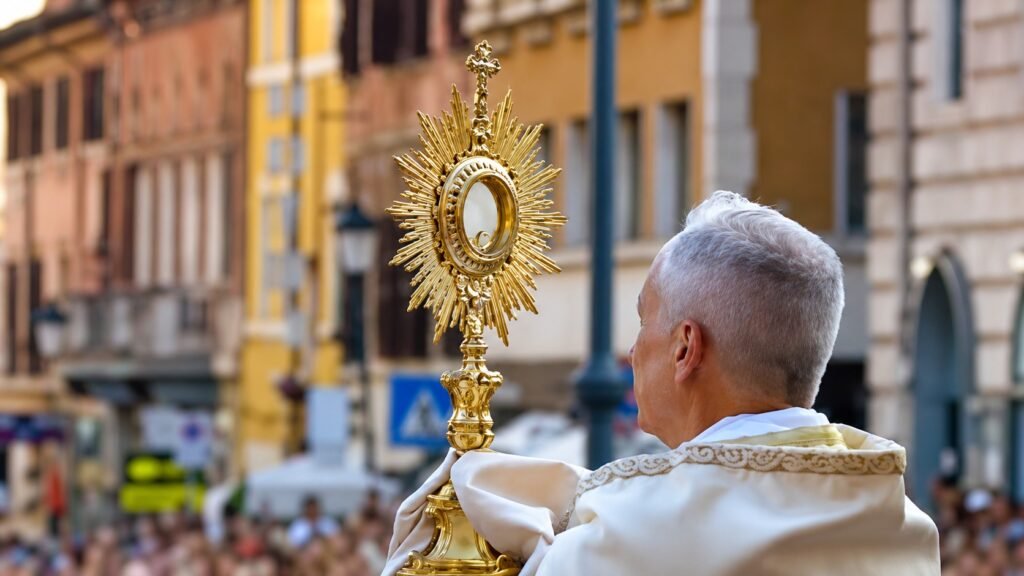
For this reason, echoing the Apostle Paul (cf. 1 Cor 10:17), the Second Vatican Council teaches that “in the sacrament of the Eucharistic bread, the unity of believers, who form one body in Christ, is both expressed and achieved. All are called to this union with Christ, who is the light of the world, from whom we come, through whom we live, and towards whom we direct our lives” (Dogmatic Constitution Lumen Gentium, 3). The procession that we are about to undertake is a sign of that journey. Together, as shepherds and flock, we will feed on the Blessed Sacrament, adore him and carry him through the streets. In doing so, we will present him before the eyes, the consciences and the hearts of the people. To the hearts of those who believe, so that they may believe more firmly; to the hearts of those who do not believe, so that they may reflect on the hunger present within them and the bread that alone can satisfy it.
Strengthened by the food that God gives us, let us bring Jesus to the hearts of all, because Jesus involves everyone in his work of salvation by calling each of us to sit at his table. Blessed are those who are called, for they become witnesses of this love!
Copyright © Dicastery for Communication – Libreria Editrice Vaticana
Source: https://www.vatican.va/content/leo-xiv/en/homilies/2025/documents/20250622-omelia-corpus-domini.html
Stay updated: subscribe by email for free TO OUR NEW WEBSITE catholicsstrivingforholiness.org (PUT YOUR EMAIL IN THE SUBSCRIBE WIDGET).
If you need some resources regarding a particular topic, feel free to use the search WIDGET which has access to thousands of posts, categories and tags on Catholic spirituality.
Cordially inviting you as well to follow www.fb.com/Catholicsstrivingforholiness. and share our posts to help more people in their Christian faith and life.
Thanks and God bless you and your loved ones! Fr. Rolly Arjonillo.