SOLEMNITY OF THE ASSUMPTION OF THE BLESSED VIRGIN MARY
HOMILY OF HIS HOLINESS POPE LEO XIV
Pontifical Parish of Saint Thomas of Villanova (Castel Gandolfo)
Saturday 15 August 2026
Dear brothers and sisters,
It is with great joy that I celebrate the Solemnity of the Assumption with you once again this year.The Magisterium of the Church teaches us that Mary “having completed the course of her earthly life, was assumed body and soul into heavenly glory” (Pius XII, Apostolic Constitution Munificentissimus Deus, 1 November 1950) and points out to us, in this Mystery, the fulfillment of the most perfect grace that God bestowed upon her at her Immaculate Conception (cf. ibid.).
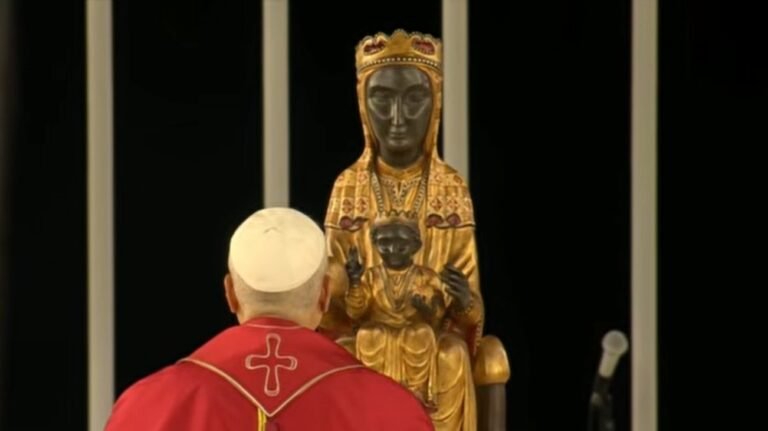
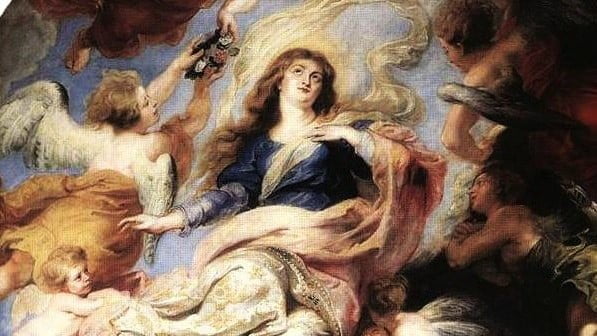
For this reason, many works of art depict her as a beautiful young woman physically rising from the earth toward the heavens at the end of her earthly life. These works are inspired by the scene described in the passage from the Book of Revelation that we heard in the First Reading: “A woman clothed with the sun, with the moon under her feet” (Rev 12:1), signifying that in Mary’s heart, heaven and earth, time and eternity, meet.
On the surface this image seems to contrast with our experience of what the passing of the years does to us. As we age, our bodies do not become more agile, but heavier; our skin does not become fresher, but shows the signs of old age; our hair does not gain color and luster, but turns gray and then white. So, what do we have in common with the beautiful young woman depicted on the altarpieces of our churches?
To understand this, we must unite the two signs we have mentioned: the incorrupt body of the Mother of God and her immaculate heart. For it is the purity of the soul that, in Mary — as in us — by the grace of God, illuminates and transfigures the whole person, leading us to the glory of Heaven.
The glorification of Mary, body and soul, teaches us that our true beauty does not lie in hiding the signs of aging, but in revealing the signs of love that never end, and are even impressed on our flesh (cf. 1 Cor 13:8).
With this in mind, we are invited to reexamine many of the aesthetic standards, predominantly hedonistic and consumerist in nature, that the world imposes on us. These standards risk trapping us in burdensome expectations, causing us to waste precious energy on what does not really matter and does not last forever. In everyday life, we encounter people whose faces are marked by the years and by suffering, yet who are capable of radiating serenity, kindness and peace around them; just as we may observe others who are perhaps outwardly attractive but hard and cold at heart. It is easy to see where true beauty lies and where, on the other hand, there is still a need for conversion, forgiveness and healing.
If we truly wish to discover and nurture the divine beauty that surrounds us and for which we were made, and to share it with those around us, we must learn to see it in the wrinkles of an elderly person as in the tender face of a child as well, in the maturity of an adult as in the liveliness of a young person as well, in work clothes and tools as well as in festive decorations. We must listen to the unique love stories that each of these realities tells us, recognizing in them small glimpses of heaven.
Love is humanity’s most beautiful adornment. Love transfigures, transforms, ennobles and lifts us up, making us light, free and close to God, even amid life’s ups and downs.
Reflecting on the mystery of the Assumption of the Virgin, Saint Paul VI said that to understand its meaning, “we must transform the terms we use in earthly and temporal language into superlative and absolute ones […], to imagine the eternal on a small scale” (Homily, 15 August 1969). Regarding the encounter between the infinite and the finite in the Mother of God, Pope Francis wrote: “Mary was able to turn a stable into a home for Jesus, with poor swaddling clothes and an abundance of love” (Apostolic Exhortation Evangelii Gaudium, 286).
The miracle that Mary, the maiden of Nazareth, experienced in her innocent heart, which led her to the glory of Heaven, is a meeting of extremes, as she herself testifies in the inspired words of the Magnificat, which we heard in the Gospel (cf. Lk 1:46–55). In this canticle, through the humble expressions of her faith, the Mother of God speaks to us in simple terms of the magnificent mysteries she experienced, such as God becoming man in her to save humanity, and the Eternal One revealing himself within time to reopen the path to eternity for us. At the same time, in her position as a “humble servant,” Saint Paul VI says that Mary shows us the “humble dimension” in which we too can encounter the Lord.
We need not look far to find the sublimity of the Mystery we celebrate. We can encounter it wherever there is true charity. For example, in the eyes of a father and mother returning home after a long day, tired but happy to be with their children. In the faces of grandfathers and grandmothers who, despite the aches and pains of old age, are filled with unexpected energy as they care for their grandchildren. In the commitment of young people who strive to grow in morality and sincerity, ready even to go against the grain of “what everyone else does.” Finally, in the daily work of so many men and women who, with faith and dedication, help bring a little bit of Heaven to earth and the earth closer to Heaven.
Dear friends, the beautiful face of Our Lady of the Assumption is unique; it transcends any possible representation, and yet, at the same time, is familiar to us. Even at this very moment, we can see her face in the people who are close to us, such as the brothers and sisters with whom, in faith, we share the daily offering of our lives. For this reason, the community of believers sees itself in the woman of the Book of Revelation, and the Second Vatican Council describes Mary as “the image and beginning of the Church, […] as a sign of sure hope and solace” (Dogmatic Constitution Lumen Gentium, 68). In her holy human nature, by the grace of God, we also see our nature; therefore, we too are called to live the same grace-filled life that she lived and to share in her glory.When speaking of Christ’s resurrection, Saint Augustine urged the Christians of his time to make it the compass and focal point of their lives. He said: “Christ rose from the dead so that He might never die again […]. Change course, follow the light! Begin to rise from the very place from which he rose” (Enarratio in Psalmos, 126:7).
Let us accept his invitation. Let us follow the light of the Risen Lord, changing course if necessary. Let us do so, especially today, by looking to Mary, whom God has crowned with glory in body and soul, and whom he has given to us as Mother, guide, companion on our journey, and protector on the path to Heaven.
Source: https://www.vatican.va/content/leo-xiv/en/homilies/2026/documents/20260815-omelia-castelgandolfo.html
Pontifical Parish of Saint Thomas of Villanova (Castel Gandolfo)
Friday, 15 August 2025
________________________________________
Dear brothers and sisters,
Today is not Sunday, yet we celebrate in another way the Paschal Mystery of Jesus, which changed the course of history. In Mary of Nazareth, we recognize our own history: the history of the Church, immersed in the common lot of humanity. By taking flesh in her, the God of life — the God of freedom — has conquered death. Yes, today we contemplate how God overcomes death — yet never without us. His is the Kingdom, but ours is the “yes” to his love that can change everything. On the Cross, Jesus freely uttered that “yes” which would strip death of its power — the death that still spreads wherever our hands crucify and our hearts remain imprisoned by fear and mistrust. On the Cross, trust prevailed; so did love, which sees what is yet to come; and forgiveness triumphed.
Mary was there, united with her Son. In our day, we are like Mary whenever we do not flee, whenever we make Jesus’ “yes” our own. That “yes” still lives and resists death in the martyrs of our time, in witnesses of faith and justice, of gentleness and peace. Thus this day of joy becomes also a day that calls us to choose – how and for whom we shall live.
The liturgy of this feast of the Assumption offers us the Gospel passage on the Visitation. Saint Luke recorded in this passage a decisive moment in Mary’s vocation. It is beautiful to recall that day, as we celebrate the crowning moment of her life. Every human story, even that of the Mother of God, is brief on this earth and comes to an end. Yet nothing is lost. When a life ends, its uniqueness shines even more clearly. The Magnificat, which the Gospel places on the lips of the young Mary, now radiates the light of all her days. One single day — the day she met her cousin Elizabeth — contains the seed of every other day, of every other season. And words are not enough; a song is needed, one that continues to be sung in the Church “from generation to generation” (Lk 1:50), at the close of every day. The surprising fruitfulness of barren Elizabeth confirmed Mary in her trust; it anticipated the fruitfulness of her “yes,” which extends to the fruitfulness of the Church and of all humanity whenever God’s renewing Word is welcomed. That day, two women met in faith, then stayed together for three months to support each other, not just in practical matters but in a new way of reading history.
And so, dear brothers and sisters, the Resurrection enters our world even today. The words and choices of death may seem to prevail, but the life of God breaks through our despair through concrete experiences of fraternity and new gestures of solidarity. Prior to being our final destiny, the Resurrection transforms — in soul and body — our dwelling on earth. Mary’s song, Magnificat, strengthens the hope of the humble, the hungry, the faithful servants of God. These are the men and women of the Beatitudes who, even in tribulation, already see the invisible: the mighty cast down from their thrones, the rich sent away empty, the promises of God fulfilled. Such experiences should be found in every Christian community. They may seem impossible, but God’s Word continues to be brought to light. When bonds are born, with which we confront evil with good and death with life, we see that nothing is impossible with God (cf. Lk 1:37).
Sometimes, unfortunately, where human self-reliance prevails, where material comfort and a certain complacency dull the conscience, this faith can grow old. Then death enters in the form of resignation and complaint, of nostalgia and fear. Instead of letting the old world pass away, one clings to it still, seeking the help of the rich and powerful, which often comes with contempt for the poor and lowly. The Church, however, lives in her fragile members, and she is renewed by their Magnificat. Even in our own day, the poor and persecuted Christian communities, the witnesses of tenderness and forgiveness in places of conflict, and the peacemakers and bridge-builders in a broken world, are the joy of the Church. They are her enduring fruitfulness, the first fruits of the Kingdom to come. Many of them are women, like the elderly Elizabeth and the young Mary — Paschal women, apostles of the Resurrection. Let us be converted by their witness!
Brothers and sisters, when in this life we “choose life” (Dt 30:19), we are right to see in Mary, assumed into heaven, our own destiny. She is given to us as the sign that the Resurrection of Jesus was no isolated event, no mere exception. In Christ, we, too, can “swallow up death” (cf. 1 Cor 15:54). To be sure, it is God’s work, not ours. Yet Mary is that wondrous union of grace and freedom, which urges each of us to have trust, courage and participation in the life of God’s people. “He who is mighty has done great things for me” (Lk 1:49): may each of us know this joy and proclaim it with a new song. Let us not be afraid to choose life! It may seem risky and imprudent. Many voices whisper: “Why bother? Let it go. Think of your own interests.” These are voices of death. But we are disciples of Christ. It is his love that drives us — soul and body — in our time. As individuals and as the Church, we no longer live for ourselves. This — and only this — spreads life and lets life prevail. Our victory over death begins here and now.
Copyright © Dicastery for Communication – Libreria Editrice Vaticana
Source: https://www.vatican.va/content/leo-xiv/en/homilies/2025/documents/20250815-omelia-castelgandolfo.html
See as well:
Stay updated: subscribe by email for free TO OUR NEW WEBSITE catholicsstrivingforholiness.org (PUT YOUR EMAIL IN THE SUBSCRIBE WIDGET).
If you need some resources regarding a particular topic, feel free to use the search WIDGET which has access to thousands of posts, categories and tags on Catholic spirituality.
Cordially inviting you as well to follow www.fb.com/Catholicsstrivingforholiness. and share our posts to help more people in their Christian faith and life.
Thanks and God bless you and your loved ones! Fr. Rolly Arjonillo.