POPE FRANCIS ON THE 20TH SUNDAY IN ORDINARY TIME YEAR B
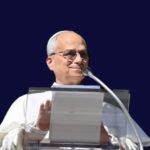
ANGELUS
Saint Peter’s Square
Sunday, 18 August 2024
________________________________________
Dear brothers and sisters, happy Sunday!
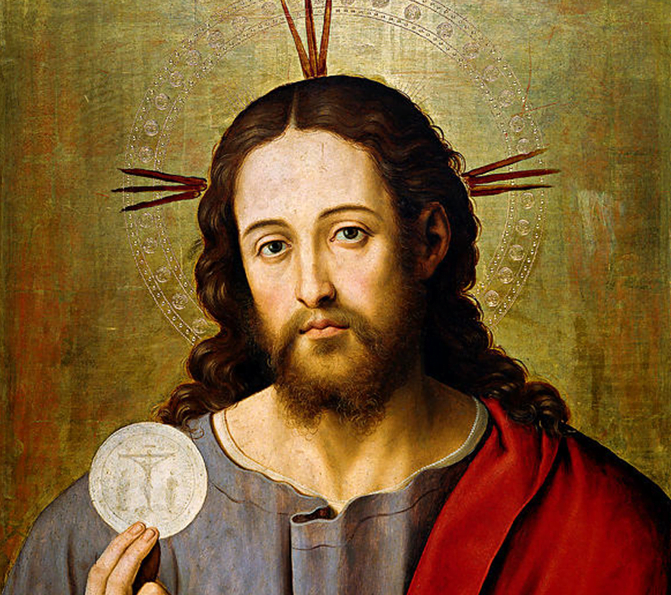
Today, the Gospel tells us about Jesus, who says, very simply: “I am the living bread that came down from heaven” (Jn 6:51). Before the crowd, the Son of God identifies himself with the most common and ordinary food- bread: “I am the bread”. Among those who are listening to Him, some start arguing among themselves (cf. v. 52): how can Jesus give us His own flesh to eat? Even today, we ask ourselves this question, but with wonder and gratitude. Here are two attitudes to reflect on: wonder and gratitude before the miracle of the Eucharist.
Firstly: wonder, because Jesus’ words surprise us. But Jesus always surprises us, always! Also today, in the lives of each one of us, Jesus keeps surprising us. The bread from heaven is a gift that exceeds all expectations. Those who do not grasp Jesus’ way remain suspicious: it seems impossible, even inhuman, to eat the flesh of another (cf. v. 54). Flesh and blood, however, are the humanity of the Saviour, His very life offered as a nourishment for our own.
And this brings us to the second attitude: gratitude. First: wonder. Now, gratitude, because we recognize Jesus where He makes Himself present for us and with us. He makes Himself bread for us. “Whoever eats my flesh remains in me and I in him” (cf. v. 56). Christ, the true man, knows well that one must eat to live. But He also knows that this is not enough. After multiplying the earthly bread (cf. Jn 6:1-14), He prepares an even greater gift: He Himself becomes true food and true drink (cf. v. 55). Thank you, Lord Jesus! Let us say “Thank you, thank you” with all our heart.
The heavenly bread, which comes from the Father, is the Son Himself made flesh for us. This food is more than necessary because it satisfies the hunger for hope, the hunger for truth, and the hunger for salvation that we all feel not in our stomachs, but in our hearts. Every one of us needs the Eucharist!
Jesus takes care of the greatest need: He saves us, nourishing our lives with His own, and He will do this forever. And it is thanks to Him that we can live in communion with God and with each other. The living and true bread is not, therefore, something magical, no. It is not something that will immediately solve all problems, but it is the very Body of Christ, that gives hope to the poor and overcomes the arrogance of those who gorge themselves at their expense.
Let us ask ourselves, then, brothers and sisters: Do I hunger and thirst for salvation, not just for myself, but for all my brothers and sisters? When I receive the Eucharist, which is the miracle of mercy, do I stand in awe before the Body of the Lord, who died and rose again for us?
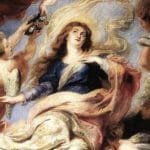
Let us pray together to the Virgin Mary, that she may help us to welcome the gift of heaven in this sign of the bread.
Source: https://www.vatican.va/content/francesco/en/angelus/2024/documents/20240818-angelus.html
EMPHASIS MINE.
ANGELUS
Saint Peter’s Square
20th Sunday in Ordinary Time B, 19 August 2018
Dear Brothers and Sisters, Good morning!
This Sunday’s Gospel passage (cf. Jn 6:51-58) introduces us to the second part of the discourse that Jesus delivers in the Synagogue of Capernaum, after having satisfied the hunger of the great multitude with five loaves and two fish: the multiplication of the loaves. He presents himself as “the bread which came down from heaven”, the bread that gives eternal life, and he adds: “the bread which I shall give for the life of the world is my flesh” (v. 51).
This passage is decisive, and in fact it provokes the reaction of those who are listening, who begin to dispute among themselves: “How can this man give us his flesh to eat?” (v. 52). When the sign of the shared bread points to its true significance, namely, self-giving to the point of sacrifice, misunderstanding arises; it leads to the actual rejection of the One whom, shortly before, they had wanted to lift up in triumph. Let us remember that Jesus had to hide because they had wanted to make him king.
Jesus continues: “unless you eat the flesh of the Son of man and drink his blood, you have no life in you” (v. 53). Here the blood is present together with the flesh. In biblical language, flesh and blood express concrete humanity. The people and the disciples themselves sense that Jesus invites them to enter into communion with him, to ‘eat’ him, his humanity, in order to share with him the gift of life for the world. So much for triumphs and mirages of success! It is precisely the sacrifice of Jesus who gives himself for us.
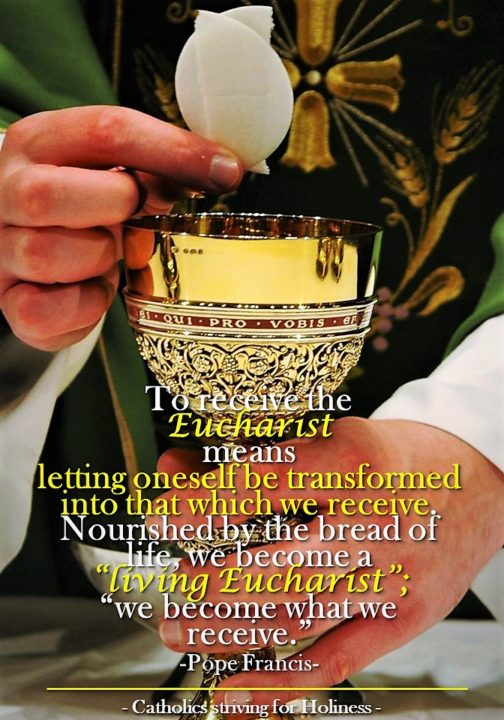
This bread of life, the sacrament of the Body and Blood of Christ, comes to us freely given at the table of the Eucharist. Around the altar we find what spiritually feeds us and quenches our thirst today and for eternity. Each time we participate in the Holy Mass, in a certain sense, we anticipate heaven on earth, because from the Eucharistic sustenance, the Body and Blood of Jesus, we learn what eternal life is.It is living for the Lord: “he who eats me will live because of me” (v. 57), the Lord says. The Eucharist shapes us so that we live not only for ourselves but for the Lord and for our brothers and sisters. Life’s happiness and eternity depend on our ability to render fruitful the evangelical love we receive in the Eucharist.
As in that time, today too Jesus repeats to each of us: “unless you eat the flesh of the Son of man and drink his blood, you have no life in you” (v. 53). Brothers and sisters, it is not about material sustenance, but a living and life-giving bread, which conveys the very life of God. When we receive Communion we receive the very life of God. To have this life it is necessary to nourish ourselves of the Gospel and of the love of our brothers and sisters. Before Jesus’ invitation to nourish ourselves of his Body and of his Blood, we might feel the need to dispute and to resist, as did those listeners whom today’s Gospel spoke of. This happens when we struggle to model our existence after that of Jesus, to act according to his criteria and not according to worldly criteria. By nourishing ourselves of this food we can enter into full harmony with Christ, with his sentiments, with his behaviour. This is so important: to go to Mass and partake in Communion, because receiving Communion is receiving this living Christ, who transforms us within and prepares us for heaven.
May the Virgin Mary support our aim to enter into communion with Jesus Christ, by nourishing ourselves of his Eucharist, so as to become in our turn bread broken for our brothers and sisters.
Source: https://www.vatican.va/content/francesco/en/angelus/2018/documents/papa-francesco_angelus_20180819.html
ANGELUS
Saint Peter’s Square
Sunday, 16 August 2015
Dear Brothers and Sisters, Good morning!
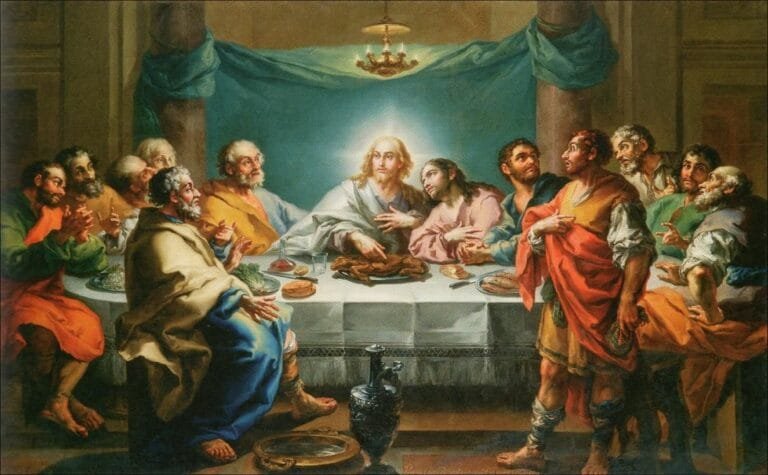
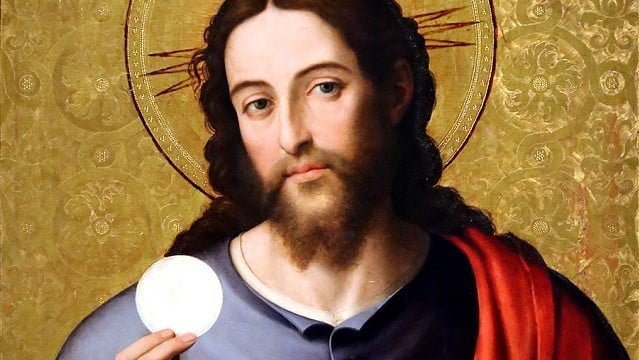
These Sundays the Liturgy is offering us, from the Gospel according to John, Jesus’ discourse on the Bread of Life, which He himself is, just as the Sacrament of the Eucharist is. Today’s passage (Jn 6:51-58) presents the final part of this discussion, and refers to several of those who were scandalized because Jesus said: “he who eats my flesh and drinks my blood has eternal life, and I will raise him up at the last day” (Jn 6:54). The listeners’ astonishment is understandable; Jesus in fact uses the typical manner of the prophets to provoke questions in people — and also in us — and, ultimately, to provoke a decision. First of all, regarding the questions: what is meant by “eat the flesh and drink the blood” of Jesus? Is it just an image, a figure of speech, a symbol, or does it indicate something real? In order to answer, one must divine what is happening in Jesus’ heart as he breaks the bread for the hungry crowd. Knowing that he will have to die on the cross for us, Jesus identifies himself with that bread broken and shared, and it becomes for him the “sign” of the Sacrifice that awaits him. This process culminates in the Last Supper, where the bread and wine truly become his Body and his Blood. It is the Eucharist, which Jesus leaves us with a specific purpose: that we may become one with Him. Indeed he says: “He who eats my flesh and drinks my blood abides in me, and I in him” (v. 56). That “abiding”: Jesus in us and we in Jesus. Communion is assimilation: partaking of Him, we become as He is. This requires our “yes”, our adherence of faith.
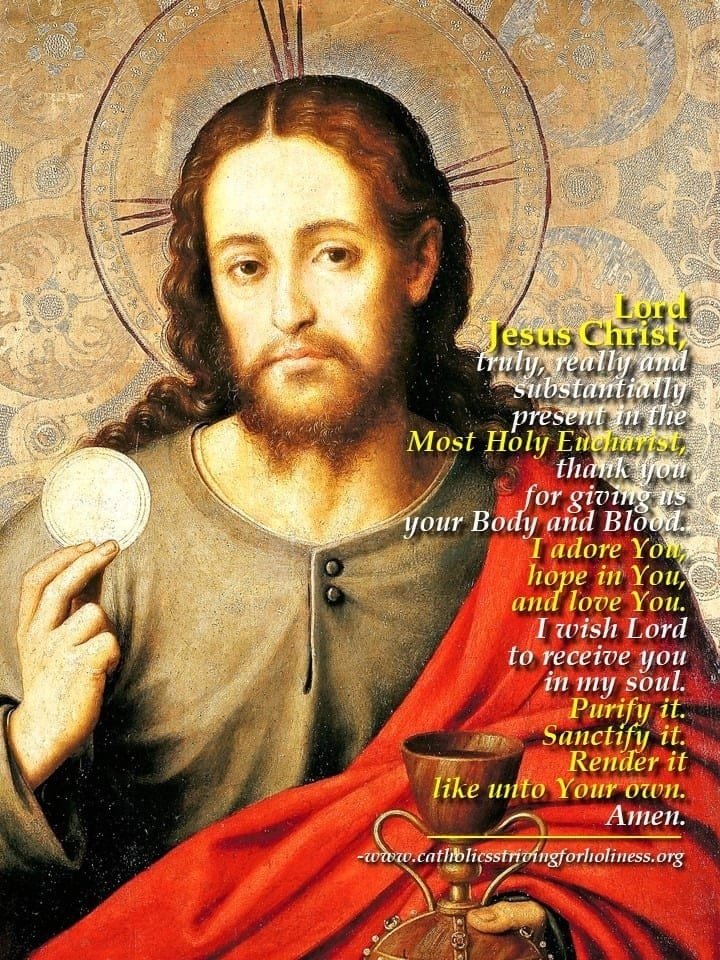
Regarding the Holy Mass, one sometimes hears this objection: “Of what use is Mass? I go to Church when I feel like it, and I pray better in solitude”. But the Eucharist is not a private prayer or a beautiful spiritual exercise, it is not a simple commemoration of what Jesus did at the Last Supper. We say, in order to fully understand, that the Eucharist is “a remembrance”, that is, a gesture which renders real and present the event of Jesus’ death and resurrection: the bread really is his Body given up for us, the wine really is his Blood poured out for us.
The Eucharist is Jesus himself who gives himself entirely to us. Nourishing ourselves of Him and abiding in Him through Eucharistic Communion, if we do so with faith, transforms our life, transforms it into a gift to God and to our brothers and sisters. Nourishing ourselves of that “Bread of Life” means entering into harmony with the heart of Christ, assimilating his choices, his thoughts, his behaviour. It means entering into a dynamism of love and becoming people of peace, people of forgiveness, of reconciliation, of sharing in solidarity. The very things that Jesus did.
Jesus concludes his discourse with these words: “he who eats this bread will live for ever” (Jn 6:58). Yes, living in real communion with Jesus on this earth lets us pass from death to life. Heaven begins precisely in this communion with Jesus.
In Heaven Mary our Mother is already waiting for us — we celebrated this mystery yesterday. May she obtain for us the grace to nourish ourselves with faith in Jesus, Bread of Life.
Source: https://www.vatican.va/content/francesco/en/angelus/2015/documents/papa-francesco_angelus_20150816.html
EMPHASIS MINE
Copyright © Dicastero per la Comunicazione – Libreria Editrice Vaticana
SEE AS WELL:
Stay updated: subscribe by email for free TO OUR NEW WEBSITE catholicsstrivingforholiness.org (PUT YOUR EMAIL IN THE SUBSCRIBE WIDGET).
If you need some resources regarding a particular topic, feel free to use the search WIDGET which has access to thousands of posts, categories and tags on Catholic spirituality.
Cordially inviting you as well to follow www.fb.com/Catholicsstrivingforholiness. and share our posts to help more people in their Christian faith and life.
Thanks and God bless you and your loved ones! Fr. Rolly Arjonillo.