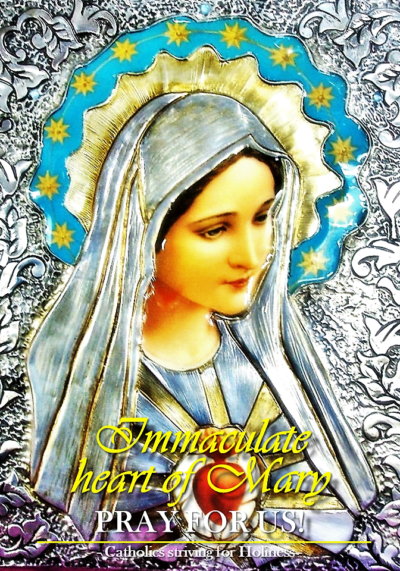
DAILY GOSPEL COMMENTARY: IMMACULATE HEART OF MARY
(Lk 2:41–51).
(Lk 2:41–51).
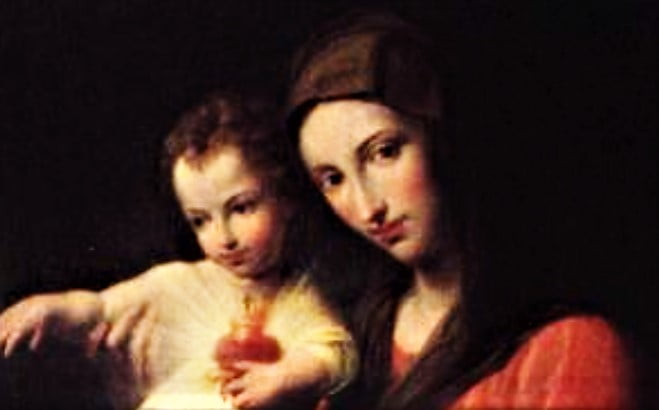
Gospel of the Memorial of the Immaculate Heart of Mary
The finding of the Child Jesus in the temple
Each year his parents went to Jerusalem for the feast of Passover, and when he was twelve years old, they went up according to festival custom. After they had completed its days, as they were returning, the boy Jesus remained behind in Jerusalem, but his parents did not know it. Thinking that he was in the caravan, they journeyed for a day and looked for him among their relatives and acquaintances, but not finding him, they returned to Jerusalem to look for him. After three days they found him in the temple, sitting in the midst of the teachers, listening to them and asking them questions, and all who heard him were astounded at his understanding and his answers. When his parents saw him, they were astonished, and his mother said to him, “Son, why have you done this to us? Your father and I have been looking for you with great anxiety.” And he said to them, “Why were you looking for me? Did you not know that I must be in my Father’s house?” But they did not understand what he said to them. He went down with them and came to Nazareth, and was obedient to them; and his mother kept all these things in her heart.
Gospel Commentary from the Navarre Bible, Commentary to the Gospel of St. Luke (with permission)
41 Each year his parents went to Jerusalem for the feast of Passover, and when he was twelve years old, they went up according to festival custom. After they had completed its day41
- Only St Luke (2:41-50) reports the event of the Child Jesus being lost and then found in the Temple, which we contemplate in the fifth joyful mystery of the Rosary.
- Only males aged twelve and upwards were required to make this journey. Nazareth is about 100 kms (60 miles) from Jerusalem as the crow flies, but the hilly nature of the country would have made it a trip of 140 kms.
43-44 After they had completed its days, as they were returning, the boy Jesus remained behind in Jerusalem, but his parents did not know it. Thinking that he was in the caravan, they journeyed for a day and looked for him among their relatives and acquaintances,
- On pilgrimages to Jerusalem, the Jews used to go in two groups — one of men, the other of women. Children could go with either group. This explains how they could go a day’s journey before they discovered the Child was missing when the families regrouped to camp.
- “Mary is crying. In vain you and I have run from group to group, from caravan to caravan: no one has seen him. Joseph, after fruitless attempts to keep from crying, cries too…. And you … And I.
- “Being a common little fellow, I cry my eyes out and wail to heaven and earth … to make up for the times when I lost him through my own fault and did not cry” (St. Josemaria, Holy Rosary, fifth joyful mystery).
45 but not finding him, they returned to Jerusalem to look for him.
- The concern which Mary and Joseph show in looking for the Child Jesus should encourage us always to seek Jesus out, particularly if we lose him through sin.
- “Jesus: may I never lose you again … Now you and I are united in misfortune and grief, as we were united in sin. And from the depths of our being come sighs of heartfelt sorrow and burning phrases which the pen cannot and should not record” (St. Josemaria, Holy Rosary, fifth joyful mystery).
46-47 After three days they found him in the temple, sitting in the midst of the teachers, listening to them and asking them questions, and all who heard him were astounded at his understanding and his answers.
- The Child Jesus must have been in the courtyard of the Temple, which was where the teachers usually taught. Listeners used to sit at their feet, now and again asking questions and responding to them. This was what Jesus did, but his questions and answers attracted the teachers’ attention, he was so wise and well-informed.
48 When his parents saw him, they were astonished, and his mother said to him, “Son, why have you done this to us? Your father and I have been looking for you with great anxiety.”
- Ever since the Annunciation our Lady had known that the Child Jesus was God. This faith was the basis of her generous fidelity throughout her life — but there was no reason why it should include detailed knowledge of all the sacrifices God would ask of her, nor of how Christ would go about his mission of redemption: that was something she would discover as time went by, contemplating her Son’s life.
49 And he said to them, “Why were you looking for me? Did you not know that I must be in my Father’s house?”
- Christ’s reply is a form of explanation. His words — his first words to be recorded in the Gospel — clearly show his divine Sonship; and they also show his determination to fulfil the will of his Eternal Father. “He does not upbraid them — Mary and Joseph — for searching for their son, but he raises the eyes of their souls to appreciate what he owes Him whose Eternal Son he is”(St Bede, In Lucae Evangelium expositio, in loc.).
- Jesus teaches us that over and above any human authority, even that of our parents, there is the primary duty to do the will of God.
- “And, once we are consoled by the joy of finding Jesus — three days he was gone! — debating with the teachers of Israel (Lk 2:46), you and I shall be left deeply impressed by the duty to leave our home and family to serve our heavenly Father” (St. Josemaria, Holy Rosary, fifth joyful mystery).[…]
50 He went down with them and came to Nazareth, and was obedient to them; and his mother kept all these things in her heart.
- We must remember that Jesus knew in detail the whole course his earthly life would take from his conception onwards (cf. note on Lk 2:52). This is shown by what he says in reply to his parents. Mary and Joseph realized that his reply contained a deeper meaning which they did not grasp. They grew to understand it as the life of their Child unfolded. Mary’s and Joseph’s faith and their reverence towards the Child led them not to ask any further questions but to reflect on Jesus’ words and behaviour in this instance, as they had done on other occasions.
Dear friends, Mary and Joseph did not understand Jesus’ reply: “Why were you looking for me? Did you not know that I must be in my Father’s house?” but their reaction was that of accepting God’s plans with humility and docility. This is a wonderful lesson for all of us. God invites us to accept with love the manifestations of His Divine Providence although at times we do not understand them. Let us learn to entrust ourselves to His plans without comprehending it entirely convinced that God has far greater plans for us than what we have envisioned.
Let us ask the help of Our Lady so that we may have a heart like hers and that of Jesus, always disposed to accept God’s Will. Immaculate Heart of Mary, pray for us!
A Blessed Saturday ahead!
Fr. Rolly Arjonillo
COMMENTARY ON THE GOSPEL OF THE FEAST OF THE IMMACULATE HEART OF MARY
Today we celebrate in the Church the feast of the Immaculate Heart of Mary. The Hearts of Jesus and Mary were wonderfully united from the moment of the Incarnation. The Church teaches us that the surest way to reach Jesus is through Mary. Pope Pius XII stablished this feast for the entire Church on 4 May 1944. Through Mary’s intercession we ask for “peace among nations, freedom for the Church, the conversion of sinners, the love of purity and the practice of virtue” (Decree of May 4, 1944).
In today’s Gospel passage, the Holy Family travels to the Temple of Jerusalem. They do so out of devotion. The Law of Moses obliged the men of Israel to appear before the Lord three times a year: at Passover, at Pentecost, and at the Feast of Tabernacles. This duty did not affect women or children before they turned 13. Furthermore, in Jesus’ time only those who lived less than a day’s journey away usually made this pilgrimage, and normally only for the feast of Passover. Since the journey from Nazareth to Jerusalem required a number of days, Joseph was not strictly bound by the precept either. However, both he and Mary went to Jerusalem every year for the Passover (cf. Lk 2:41).
On the way back, men and women traveled separately. Children could join either group. Mary and Joseph realized that Jesus was missing and, distraught, they looked for him among their relatives and acquaintances. On failing to find him, perhaps that same night they returned to Jerusalem. On the third day of searching they found him in the Temple, sitting in the middle of the teachers, listening to them and asking questions. “And all who heard him were amazed at his understanding and his answers.”
Our Lady and her Spouse were also amazed. But their astonishment was not due to the wisdom of his answers, but because it was the first time that something like this had happened: Jesus, who was always so obedient, had stayed in Jerusalem without telling them.
“’Son, why have you treated us so? Behold, your father and I have been looking for you anxiously.’ And he said to them, ‘How is it that you sought me? Did you not know that I must be in my Father’s house?’” But they didn’t understand his answer.
Jesus wants to reveal the mysterious depth of his intimacy with the Father, something Mary senses but doesn’t know how to connect with the trial Jesus has put them through. Upon receiving that answer, without understanding it Mary and Joseph obeyed God’s plans, with complete humility and docility. They returned to Nazareth, and Jesus “was obedient to them; and his mother kept all these things in her heart.”
It is a lesson for all Christians, inviting us to accept with love the manifestations of divine Providence even when sometimes we fail to understand them. The heart of Mary is completely united to the heart of Jesus. She doesn’t understand, but she trusts because she knows that God’s plans are always much bigger than ours. Let us ask Mary to have a heart like hers, always ready to accept God’s will.
Immaculate Heart of Mary, pray for us!
Source: https://opusdei.org/en-us/gospel/2025-06-28
VIDEO COMMENTARY ON TODAY’S GOSPEL
TOPIC 1: DO YOU ALWAYS MISS THE B.U.S. IN GOING TO THE HOUSE OF GOD?
We reflect today on our relationship, or its non-existence, with our Heavenly Father. While we all aspire for lasting happiness, we may not really know how and miss the B.U.S. entirely, depriving us of the richness of life.
TOPIC 2: DOES YOUR LOVE FOR GOD WAVER WHEN YOU ENCOUNTER PROBLEMS?
Today we celebrate the Memorial of the Immaculate Heart of Mary. It is celebrated a day after that of the Solemnity of the Sacred Heart of Jesus. The devotion to these two hearts was promoted to honor the deep love of God for his children and the response of man to love back in return through the example of Mary.
TOPIC 2: Are you ready to let go of your children to face the world?
At some point in our lives as parents, we will need to grow up. It is not the growing up that is associated with our biological age but one that involves our act of letting go. Letting go of our children often times is difficult to do. It may be an arduous process that we go through with a lot of discomfort and, perhaps, pain; especially when we feel we have not given them enough. But what is enough?
Preparing our children to face life on their own is our role as parents. While we may not be with them most of their waking life, we must take every opportunity to teach them about life.
As parents, we may face that uncomfortable realization that, at a certain age, our children will not be as docile and obedient as before. The comfort zone we used to stay in may now be unstable as our children start to chart their own lives. We must allow them to commit mistakes and learn for themselves but always with a word of caution, reminder, advice and counselling — whether they like it or not.
When my children became teenagers, they desired more freedom. But we did not give it to them immediately. We loosened the rope gradually as we saw them doing things responsibly and pulled the rope when we felt we needed to guide them some more.
When our children start to feel hemmed in by our constant reminders, my standard statement to them would be, “Son, I will be remiss in my role if I do not say my piece. I have gone through what you are going through right now and it might help if you try to listen, even if I have told you this before.” Oftentimes, the temptation to just keep quiet and let them do their thing is there to avoid conflict. But along with prayers for their well-being is the prayer for grace to say what I need to say. Another standard line I give is, “You may not realize the significance of my reminders until you become parents yourselves.” Another is, “I could choose to remain silent and let you do what you want to do, but because I love you, I am saying this at the risk of discomfort for both of us.”
This may be cultural thing, but at the end of the day, we must never shirk from our role as parents to share the right values and form our children’s perspectives according to the ways of the Lord.
Eventually, the apprehensions, the fears for our children will go away as they show that they know how to make the right, and even the wrong decisions, that would help them survive the harshness of the world around them.
But never be remiss in teaching them to pray and being with them in prayer because God’s grace will be their guide, the angels their guard, and Mama Mary, their intercessor to Jesus.
Stay updated: subscribe by email for free TO OUR NEW WEBSITE www.catholicsstrivingforholiness.org (PUT YOUR EMAIL IN THE SUBSCRIBE WIDGET).
We are also in www.fb.com/Catholicsstrivingforholiness. Kindly help more people in their Christian life by liking our page and inviting your family, friends and relatives to do so as well. Thanks in advance and God bless you and your loved ones! Fr. Rolly Arjonillo