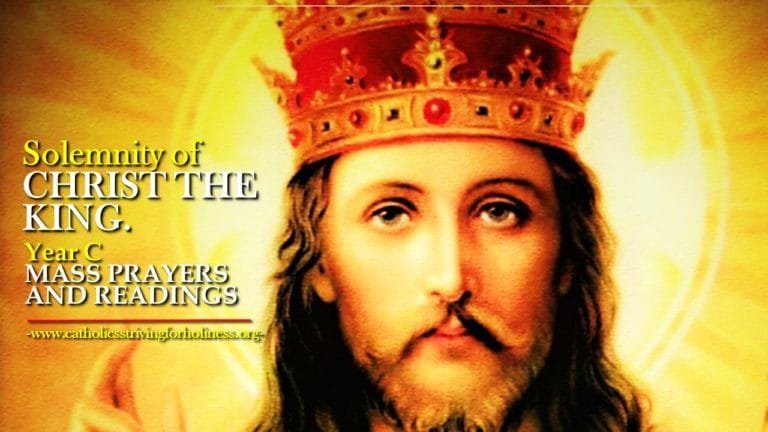
Dear brethren in Christ, below you have Pope Francis’ beautiful homily during the Holy Mass of the Solemnity of Christ the King and Closing of the Jubilee Year of Mercy (Nov. 20, 2016) which I encourage you to read and meditate in your personal prayer for it contains spiritual golden nuggets which will benefit our dealings with God and our Christian life.
Have a blessed week ahead and God bless! Fr. Rolly A., priest of Opus Dei, Catholics striving for Holiness.
+++POPE FRANCIS’ HOMILY BEGINS HERE+++ Solemnity of Christ the King Year C 2016
The Solemnity of Our Lord Jesus Christ, King of the Universe, is the crown of the liturgical year and this Holy Year of Mercy. The Gospel in fact presents the kingship of Jesus as the culmination of his saving work, and it does so in a surprising way. “The Christ of God, the Chosen One, the King” (Lk 23:35,37) appears without power or glory: he is on the cross, where he seems more to be conquered than conqueror. His kingship is paradoxical: his throne is the cross; his crown is made of thorns; he has no sceptre, but a reed is put into his hand; he does not have luxurious clothing, but is stripped of his tunic; he wears no shiny rings on his fingers, but his hands are pierced with nails; he has no treasure, but is sold for thirty pieces of silver.
Jesus’ reign is truly not of this world (cf. Jn 18:36); but for this reason, Saint Paul tells us in the Second Reading, we find redemption and forgiveness (cf. Col 1:13-14). For the grandeur of his kingdom is not power as defined by this world, but the love of God, a love capable of encountering and healing all things. Christ lowered himself to us out of this love, he lived our human misery, he suffered the lowest point of our human condition: injustice, betrayal, abandonment; he experienced death, the tomb, hell. And so our King went to the ends of the universe in order to embrace and save every living being. He did not condemn us, nor did he conquer us, and he never disregarded our freedom, but he paved the way with a humble love that forgives all things, hopes all things, sustains all things (cf. 1 Cor 13:7). This love alone overcame and continues to overcome our worst enemies: sin, death, fear.
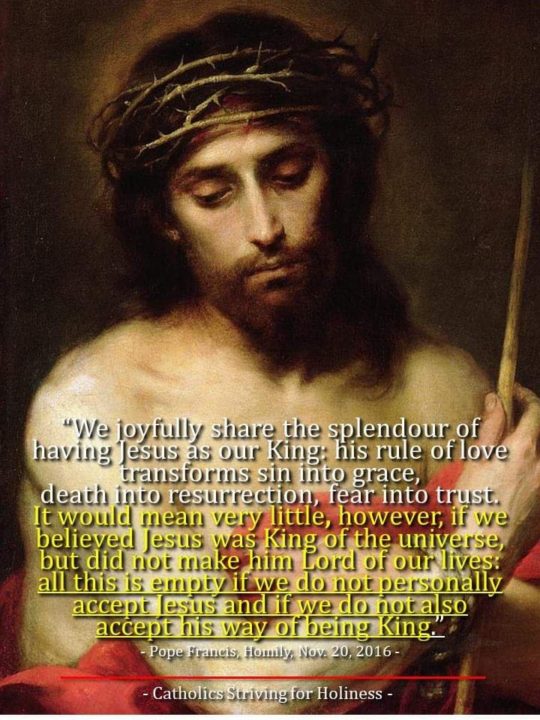
Dear brothers and sisters, today we proclaim this singular victory, by which Jesus became the King of every age, the Lord of history: with the sole power of love, which is the nature of God, his very life, and which has no end (cf. 1 Cor 13:8). We joyfully share the splendour of having Jesus as our King: his rule of love transforms sin into grace, death into resurrection, fear into trust.
It would mean very little, however, if we believed Jesus was King of the universe, but did not make him Lord of our lives: all this is empty if we do not personally accept Jesus and if we do not also accept his way of being King. The people presented to us in today’s Gospel, however, help us. In addition to Jesus, THREE FIGURES appear: the people who are looking on, those near the cross, and the criminal crucified next to Jesus.
First, the PEOPLE: the Gospel says that “the people stood by, watching” (Lk 23:35): no one says a word, no one draws any closer. The people keep their distance, just to see what is happening. They are the same people who were pressing in on Jesus when they needed something, and who now keep their distance. Given the circumstances of our lives and our unfulfilled expectations, we too can be tempted to keep our distance from Jesus’ kingship, to not accept completely the scandal of his humble love, which unsettles and disturbs us. We prefer to remain at the window, to stand apart, rather than draw near and be with him. A people who are holy, however, who have Jesus as their King, are called to follow his way of tangible love; they are called to ask themselves, each one each day: “What does love ask of me, where is it urging me to go? What answer am I giving Jesus with my life?”
There is a second group, which includes VARIOUS INDIVIDUALS: the leaders of the people, the soldiers and a criminal. They all mock Jesus. They provoke him in the same way: “Save yourself!” (Lk 23:35,37,39). This temptation is worse than that of the people. They tempt Jesus, just as the devil did at the beginning of the Gospel (cf. Lk 4:1-13), to give up reigning as God wills, and instead to reign according to the world’s ways: to come down from the cross and destroy his enemies!If he is God, let him show his power and superiority! This temptation is a direct attack on love: “save yourself” (vv. 37,39); not others, but yourself. Claim triumph for yourself with your power, with your glory, with your victory. It is the most terrible temptation, the first and the last of the Gospel. When confronted with this attack on his very way of being, Jesus does not speak, he does not react. He does not defend himself, he does not try to convince them, he does not mount a defence of his kingship. He continues rather to love; he forgives, he lives this moment of trial according to the Father’s will, certain that love will bear fruit.
In order to receive the kingship of Jesus, we are called to struggle against this temptation, called to fix our gaze on the Crucified One, to become ever more faithful to him. How many times, even among ourselves, do we seek out the comforts and certainties offered by the world. How many times are we tempted to come down from the Cross. The lure of power and success seem an easy, quick way to spread the Gospel; we soon forget how the Kingdom of God works. This Year of Mercy invites us to rediscover the core, to return to what is essential. This time of mercy calls us to look to the true face of our King, the one that shines out at Easter, and to rediscover the youthful, beautiful face of the Church, the face that is radiant when it is welcoming, free, faithful, poor in means but rich in love, on mission. Mercy, which takes us to the heart of the Gospel, urges us to give up habits and practices which may be obstacles to serving the Kingdom of God; mercy urges us to orient ourselves only in the perennial and humble kingship of Jesus, not in submission to the precarious regalities and changing powers of every age.
In the Gospel another person appears, closer to Jesus, the THIEF who begs him: “Jesus, remember me when you come into your kingdom” (v. 42). This person, simply looking at Jesus, believed in his kingdom. He was not closed in on himself, but rather – with his errors, his sins and his troubles – he turned to Jesus. He asked to be remembered, and he experienced God’s mercy: “Today you will be with me in paradise” (v. 43). As soon as we give God the chance, he remembers us. He is ready to completely and forever cancel our sin, because his memory – unlike our own – does not record evil that has been done or keep score of injustices experienced. God has no memory of sin, but only of us, of each of us, we who are his beloved children. And he believes that it is always possible to start anew, to raise ourselves up. Let us also ask for the gift of this open and living memory. Let us ask for the grace of never closing the doors of reconciliation and pardon, but rather of knowing how to go beyond evil and differences, opening every possible pathway of hope. As God believes in us, infinitely beyond any merits we have, so too we are called to instill hope and provide opportunities to others. Because even if the Holy Door closes, the true door of mercy which is the heart of Christ always remains open wide for us. From the lacerated side of the Risen One until the very end of time flow mercy, consolation and hope.
So many pilgrims have crossed the threshold of the Holy Doors, and far away from the clamour of the daily news they have tasted the great goodness of the Lord. We give thanks for this, as we recall how we have received mercy in order to be merciful, in order that we too may become instruments of mercy. Let us go forward on this road together. May our Blessed Lady accompany us, she who was also close to the Cross, she who gave birth to us there as the tender Mother of the Church, who desires to gather all under her mantle. Beneath the Cross, she saw the good thief receive pardon, and she took Jesus’ disciple as her son. She is Mother of Mercy, to whom we entrust ourselves: every situation we are in, every prayer we make, when lifted up to his merciful eyes, will find an answer.
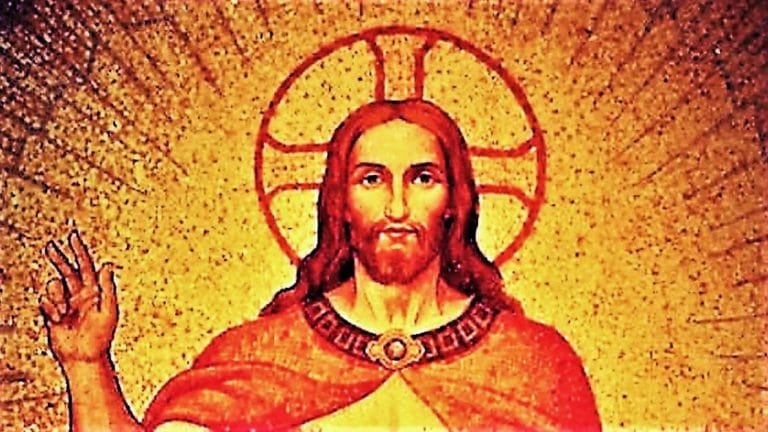
ORIGINAL PHOTO SOURCE: Attributed to Bartolomé Esteban Murillo, “Christ as the Man of Sorrows” in http://66.media.tumblr.com/010caa1b7c13891fb98e4b53139dd08e/tumblr_mozhizvB0C1qbhp9xo1_1280.jpg
HOLY MASS FOR THE CONCLUSION OF THE YEAR OF FAITH ON THE SOLEMNITY OF OUR LORD JESUS CHRIST, KING OF THE UNIVERSE
HOMILY OF POPE FRANCIS Saint Peter’s Square Feast of Christ the King Sunday, 24 November 2013
Today’s solemnity of Our Lord Jesus Christ, King of the Universe, the crowning of the liturgical year, also marks the conclusion of the Year of Faith opened by Pope Benedict XVI, to whom our thoughts now turn with affection and gratitude for this gift which he has given us. By this providential initiative, he gave us an opportunity to rediscover the beauty of the journey of faith begun on the day of our Baptism, which made us children of God and brothers and sisters in the Church. A journey which has as its ultimate end our full encounter with God, and throughout which the Holy Spirit purifies us, lifts us up and sanctifies us, so that we may enter into the happiness for which our hearts long.
[…]
The Scripture readings proclaimed to us have as their common theme the centrality of Christ. Christ is at the centre, Christ is the centre. Christ is the centre of creation, Christ is the centre of his people and Christ is the centre of history.
1. The apostle Paul, in the second reading, taken from the letter to the Colossians, offers us a profound vision of the centrality of Jesus. He presents Christ to us as the first-born of all creation: in him, through him and for him all things were created. He is the centre of all things, he is the beginning: Jesus Christ, the Lord. God has given him the fullness, the totality, so that in him all things might be reconciled (cf. Col 1:12-20). He is the Lord of creation, he is the Lord of reconciliation.
This image enables to see that Jesus is the centre of creation; and so the attitude demanded of us as true believers is that of recognizing and accepting in our lives the centrality of Jesus Christ, in our thoughts, in our words and in our works. And so our thoughts will be Christian thoughts, thoughts of Christ. Our works will be Christian works, works of Christ; and our words will be Christian words, words of Christ. But when this centre is lost, when it is replaced by something else, only harm can result for everything around us and for ourselves.
2. Besides being the centre of creation and the centre of reconciliation, Christ is the centre of the people of God. Today, he is here in our midst. He is here right now in his word, and he will be here on the altar, alive and present amid us, his people. We see this in the first reading which describes the time when the tribes of Israel came to look for David and anointed him king of Israel before the Lord (cf. 2 Sam 5:1-3). In searching for an ideal king, the people were seeking God himself: a God who would be close to them, who would accompany them on their journey, who would be a brother to them.
Christ, the descendant of King David, is really the “brother” around whom God’s people come together. It is he who cares for his people, for all of us, even at the price of his life. In him we are all one, one people, united with him and sharing a single journey, a single destiny. Only in him, in him as the centre, do we receive our identity as a people.
3. Finally, Christ is the centre of the history of humanity and also the centre of the history of every individual. To him we can bring the joys and the hopes, the sorrows and troubles which are part of our lives. When Jesus is the centre, light shines even amid the darkest times of our lives; he gives us hope, as he does to the good thief in today’s Gospel.
Whereas all the others treat Jesus with disdain – “If you are the Christ, the Messiah King, save yourself by coming down from the cross!” – the thief who went astray in his life but now repents, clings to the crucified Jesus and begs him: “Remember me, when you come into your kingdom” (Lk 23:42). Jesus promises him: “Today you will be with me in paradise” (v. 43), in his kingdom. Jesus speaks only a word of forgiveness, not of condemnation; whenever anyone finds the courage to ask for this forgiveness, the Lord does not let such a petition go unheard. Today we can all think of our own history, our own journey. Each of us has his or her own history: we think of our mistakes, our sins, our good times and our bleak times. We would do well, each one of us, on this day, to think about our own personal history, to look at Jesus and to keep telling him, sincerely and quietly: “Remember me, Lord, now that you are in your kingdom! Jesus, remember me, because I want to be good, but I just don’t have the strength: I am a sinner, I am a sinner. But remember me, Jesus! You can remember me because you are at the centre, you are truly in your kingdom!” How beautiful this is! Let us all do this today, each one of us in his or her own heart, again and again. “Remember me, Lord, you who are at the centre, you who are in your kingdom”.
Jesus’ promise to the good thief gives us great hope: it tells us that God’s grace is always greater than the prayer which sought it. The Lord always grants more, he is so generous, he always gives more than what he has been asked: you ask him to remember you, and he brings you into his kingdom!
Let us ask the Lord to remember us, in the certainty that by his mercy we will be able to share his glory in paradise. Let us go forward together on this road!
Stay updated: subscribe by email for free TO OUR NEW WEBSITE www.catholicsstrivingforholiness.org (PUT YOUR EMAIL IN THE SUBSCRIBE WIDGET). We are also in www.fb.com/Catholicsstrivingforholiness. Kindly help more people in their Christian life by liking our page and inviting your family, friends and relatives to do so as well. Thanks in advance and God bless you and your loved ones! Fr. Rolly Arjonillo