HOMILY BY HIS HOLINESS POPE LEO XIV
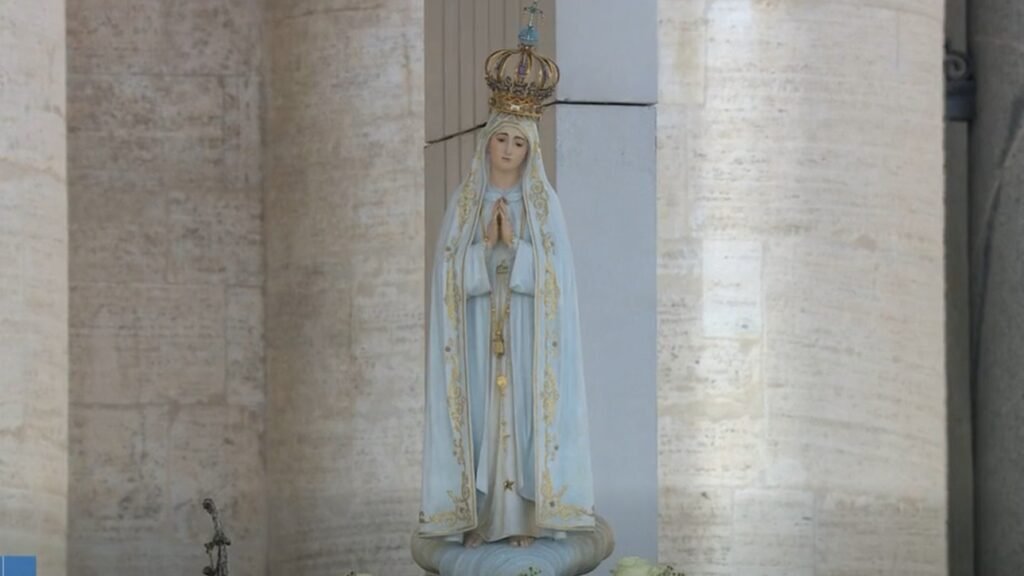
JUBILEE OF MARIAN SPIRITUALITY
St Peter’s Square
28th Sunday in Ordinary Time, 12 October 2025
____________________________________
Dear sisters and brothers,
The Apostle Paul exhorts each of us today, as he did to Timothy: “Remember Jesus Christ, raised from the dead, a descendant of David” (2 Tim 2:8). Marian spirituality, which nourishes our faith, has Jesus as its center. It is like Sunday, which opens each new week in the radiance of his Resurrection from the dead. “Remember Jesus Christ”: this alone matters; this is what distinguishes human spiritualities from the way of God. “Chained like a criminal,” (v. 9) Paul urges us not to lose sight of what is essential, and not to strip the name of Jesus of its history and of its cross. What we consider inordinate and crucify, God raises up because “he cannot deny himself” (v. 13). Jesus is God’s faithfulness, God’s faithfulness to himself. The celebration of Sunday, therefore, should make us Christians. It should fill our thoughts and feelings with the burning memory of Jesus and change the way we live together and the way we inhabit the earth. Every Christian spirituality flows from this fire and helps to keep it alive.
The reading from the Second Book of Kings (5:14-17) recounts the healing of Naaman, the Syrian. Jesus himself referred to this passage when he was in the synagogue in Nazareth (cf. Lk 4:27), and his interpretation had a disconcerting effect on the people of his hometown. To say that God had saved a foreigner suffering from leprosy rather than the many lepers in Israel turned them against him: “When they heard this, all in the synagogue were filled with rage. They got up, drove him out of the town, and led him to the brow of the hill on which their town was built, so that they might hurl him off the cliff” (Lk 4:28-29). The Evangelist makes no mention of the presence of Mary. She may have been present to witness what the elderly Simeon had announced to her when she brought the newborn Jesus to the Temple: “This child is destined for the falling and the rising of many in Israel, and to be a sign that will be opposed so that the inner thoughts of many will be revealed — and a sword will pierce your own soul too’” (Lk 2:34-35).
Yes, dear friends, “the word of God is living and active, sharper than any two-edged sword, piercing until it divides soul from spirit, joints from marrow; it is able to judge the thoughts and intentions of the heart” ( Heb 4:12). Pope Francis found the story of Naaman the Syrian to be a relevant and penetrating message for the life of the Church. Speaking to the Roman Curia, he said: “Naaman was forced to live with a tragic situation: he had leprosy. His armor, that had won him renown, in reality covered a frail, wounded and diseased humanity. We often find this contradiction in our lives: sometimes great gifts are the armor that covers great frailties. […]If Naaman had continued only to accumulate medals to decorate his armor, in the end he would have been devoured by his leprosy: appearing to be alive, yet enclosed and isolated in his disease.” [1] Jesus frees us from this danger. He does not wear armor; instead he is born and dies naked. He offers his gift without forcing the healed lepers to acknowledge him: only a Samaritan in the Gospel seems to realize that he had been saved (cf. Lk 17:11-19). Perhaps the fewer titles we have to boast of, the clearer it is that love is free. God is pure gift and sheer grace. Yet how many voices and convictions can separate us even today from this stark and revolutionary truth!
Brothers and sisters, Marian spirituality is at the service of the Gospel: it reveals its simplicity. Our affection for Mary of Nazareth leads us to join her in becoming disciples of Jesus. It teaches us to return to him and to meditate and ponder the events of our lives in which the Risen One still comes to us and calls us. Marian spirituality immerses us in the history upon which heaven opened. It helps us to see the proud being scattered in their conceit, the mighty being cast down from their thrones and the rich being sent away empty-handed. It impels us to fill the hungry with good things, to lift up the lowly, to remember God’s mercy and to trust in the power of his arm (cf. Lk 1:51-54). Jesus invites us to be part of his Kingdom, just as he asked Mary for her “yes,” which, once given, was renewed every day.
The lepers in the Gospel who do not return to give thanks remind us that God’s grace can touch us and find no response. It can heal us, yet we can still fail to accept it. Let us take care therefore not to go up to the temple in such a way that does not lead us to follow Jesus. Some forms of worship do not foster communion with others and can numb our hearts. In these cases, we fail to encounter the people God has placed in our lives. We fail to contribute, as Mary did, to changing the world, and to share in the joy of the Magnificat. Let us take care to avoid any exploitation of the faith that could lead to labelling those who are different — often the poor — as enemies, “lepers” to be avoided and rejected.
Mary’s path follows that of Jesus, which leads us to encounter every human being, especially the poor, the wounded and sinners. Because of this, authentic Marian spirituality brings God’s tenderness, his way of “being a mother,” to light in the Church. As we read in the Apostolic Exhortation Evangelii Gaudium, “whenever we look to Mary, we come to believe once again in the revolutionary nature of love and tenderness. In her, we see that humility and tenderness are not virtues of the weak but of the strong who need not treat others poorly in order to feel important themselves. Contemplating Mary, we realize that she who praised God for ‘bringing down the mighty from their thrones’ and ‘sending the rich away empty’ (Lk 1:52-53) is also the one who brings a homely warmth to our pursuit of justice” (no. 288).
Dear friends, in a world seeking justice and peace, let us revive Christian spirituality and popular devotion to the events and places blessed by God that have changed the face of the earth forever. Let us use them as a driving force for renewal and transformation. Indeed, the Jubilee we are celebrating calls for a time of conversion and restitution, of reflection and liberation. May Mary Most Holy, our hope, intercede for us and continue to lead us to Jesus, the crucified Lord. In him, there is salvation for all.
[1] Address to the Roman Curia, 23 December 2021.
Source: https://www.vatican.va/content/leo-xiv/en/homilies/2025/documents/20251012-giubileo-spiritualita-mariana.html
Copyright © Dicastery for Communication – Libreria Editrice Vaticana
MEDITATION OF THE HOLY FATHER LEO XIV
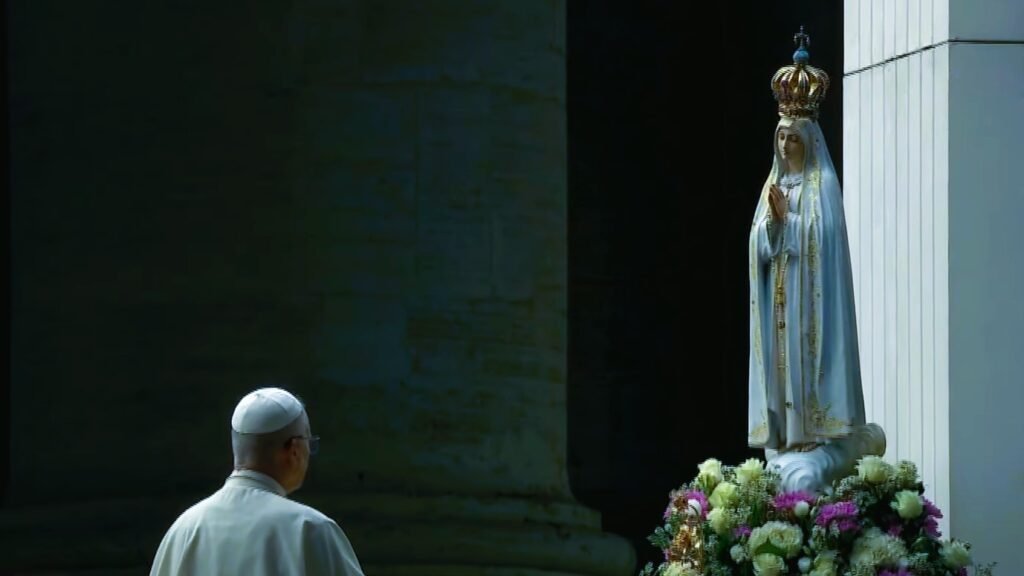
JUBILEE OF MARIAN SPIRITUALITY
PRAYER VIGIL AND ROSARY FOR PEACE
St Peter’s Square
Saturday, 11 October 2025
____________________________________
Dear brothers and sisters,
This evening, we gather in prayer with Mary, the Mother of Jesus, just as the early Church in Jerusalem did (cf. Acts 1:14). Let us all together, persevere tirelessly in praying for peace, a God-given gift that we must strive to receive and to which we must make a strong commitment.
Authentic Marian spirituality
During this Jubilee of Marian Spirituality, we believers turn our gaze to the Virgin Mary, who guides us on our pilgrimage of hope. We look to her human and evangelical virtues, the imitation of which constitutes the most authentic Marian devotion (cf. Dogmatic Constitution on the Church Lumen Gentium, 65.67). Like her, the first of all believers, we aspire to be a welcoming vessel for the Most High, a “humble tent of the Word, moved only by the motions of the Holy Spirit” (Saint John Paul II, Angelus, 15 August 1988). Like her, the first of the disciples, we ask for the gift of a listening heart that opens itself as part of a welcoming cosmos. Through her, Woman of sorrow, strength, and faith, we ask for the gift of compassion toward every brother and sister who suffers and toward all creatures.
Let us look to the Mother of Jesus and the small group of courageous women at the foot of the cross. May we learn from them to stand beside the countless crosses of the world, where Christ is still crucified in his brothers and sisters, in order to bring them comfort, communion and help. We can identify with Mary as a member of the human family, and borrowing the words of a poet, we say to her:
“Mother, you are every woman who loves;
Mother, you are every mother who weeps
for a child killed, a child betrayed.
These children who are never fully killed” (D. M. Turoldo).
We seek refuge under your protection, Virgin of Easter, together with all those in whom the Passion of your Son continues.
Do whatever he tells you
During this Jubilee of Marian Spirituality, our hope is guided by the gentle and persistent light of Mary’s words as recounted in the Gospel. Her last words at the wedding feast in Cana are particularly precious. Referring to Jesus, she said to the servants, “Do whatever he tells you” (Jn 2:5). This was the last time she spoke. These words, which almost seem to be a testament, must be treasured by her children, as any mother’s testament would be.
Whatever he tells you. She is certain that the Son will speak; that his word is not yet final; that he continues to create, generate and work; that he fills the world with springtime and the amphorae of the feast with wine. Like a beacon, Mary points beyond herself, showing that the final destination is the Lord Jesus and his word: the center toward which everything converges; the axis around which time and eternity revolve.
Follow his word, she urges. Live the Gospel: embody it, living it out with determination and joy. Live the Gospel and life will be transformed from being empty and dull to something full and vibrant.
Do whatever he tells you: the Gospel in its entirety, with all its demands and consolations, reproaches and embraces. Do what you understand and even what you do not. Mary urges us to follow the example of the prophets, not letting even one of the Lord’s words fall to the ground (cf. 1 Sam 3:19).
The words of Jesus that we should never let “fall to the ground,” and which resonate in a particular way during this vigil of prayer for peace, are those which he addressed to Peter in the Garden of Olives: “Lay down your sword” (cf. Jn 18:11). Disarm your hands and, even more importantly, your hearts. As I have said before, peace is unarmed and disarming. It is not deterrence, but fraternity; it is not an ultimatum, but dialogue. Peace will not come as the result of victories over the enemy, but as the fruit of sowing justice and courageous forgiveness.
Lay down your sword is a message addressed to the powerful of this world, to those who guide the fate of peoples: have the courage to disarm! At the same time, it is an invitation to each one of us to recognize that no idea, faith or policy justifies killing. We must first disarm our hearts because unless we have peace within ourselves, we cannot give it to others.
Let it not be so among you
Let us listen once more to the words of Jesus: the leaders of this world build empires with power and money (cf. Mt 20:25; Mk 10:42), “but not so with you” (Lk 22:26). This is not how God acts: the Master has no throne, but girds himself with a towel and kneels at the feet of each one of us. His empire is the small space required to wash the feet of his friends and care for them.
It is also an invitation to adopt a different perspective, to look at the world from a lower position: through the eyes of those who suffer rather than the mighty; to view history through the eyes of the little ones, rather than through the perspective of the powerful; to interpret the events of history from the viewpoint of the widow, the orphan, the stranger, the wounded child, the exile and the fugitive; to see things through the eyes of the shipwrecked and of the poor man Lazarus lying at the rich man’s doorstep. Otherwise, nothing will ever change, and a new era, a kingdom of justice and peace, will never dawn.
This is precisely what Mary does in the Canticle of the Magnificat when she considers the points at which humanity is broken and the world becomes distorted: the contrast between the humble and the powerful, the poor and the rich, the satiated and the hungry. She chooses the little ones; she stands with the least powerful in history, to teach us to imagine and to dream together with her of a new heavens and a new earth.
Blessed are you
Do whatever he tells you. “Blessed are you, the peacemakers” (Mt 5:9). We are dedicated to embodying the Lord’s profound words, making them a part of our very being, our legacy and our actions.
Blessed are you: God gives joy to those who spread love in the world and to those who choose to make peace with their enemies rather than defeat them.
Take courage, continue on your journey, you who are building the conditions for a future of peace, justice and forgiveness. Be gentle yet determined and never give up. Peace is a journey, and God walks with you. The Lord creates and spreads peace through his friends who are at peace in their hearts, and they in turn become peacemakers and instruments of his peace.
Like the first disciples gathered in the Upper Room, we have come together tonight in prayer around Mary, Mother of Jesus and our Mother. We turn to her, a woman of profound peace who is the Queen of Peace:
Pray with us, faithful Woman and Sacred Vessel of the Word.
Teach us to listen to the cry of the poor and of mother earth;
to be attentive to the promptings of the Spirit in the secret of our hearts,
in the lives of our brothers and sisters and in the events of history,
in the groaning and rejoicing of creation.
Holy Mary, Mother of all the Living,
strong, sorrowful, faithful Woman,
Virgin Bride at the foot of the Cross,
where love is consummated and life flows forth,
be the guide of our commitment to service.
Teach us to stand with you at the countless crosses
where your Son is still crucified,
where life is most threatened.
Teach us to live and bear witness to Christian love,
by welcoming everyone as brothers and sisters;
to renounce the darkness of selfishness
in order to follow Christ, the true light of humanity.
Virgin of peace, Gate of Sure Hope,
accept the prayers of your children!
Source: https://www.vatican.va/content/leo-xiv/en/speeches/2025/october/documents/20251011-veglia-di-preghiera.html
Copyright © Dicastery for Communication – Libreria Editrice Vaticana
Stay updated: subscribe by email for free TO OUR NEW WEBSITE catholicsstrivingforholiness.org (PUT YOUR EMAIL IN THE SUBSCRIBE WIDGET).
If you need some resources regarding a particular topic, feel free to use the search WIDGET which has access to thousands of posts, categories and tags on Catholic spirituality.
Cordially inviting you as well to follow www.fb.com/Catholicsstrivingforholiness. and share our posts to help more people in their Christian faith and life.
Thanks and God bless you and your loved ones! Fr. Rolly Arjonillo.