POPE LEO XIV ON EASTER SUNDAY
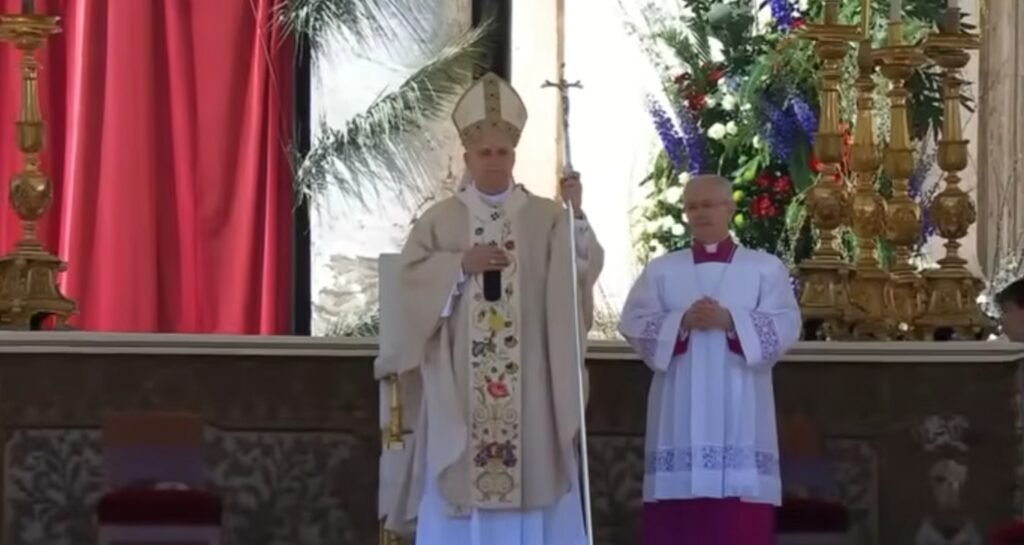
EASTER SUNDAY “RESURRECTION OF THE LORD”
HOLY MASS DURING THE DAY
PAPAL MASS
HOMILY OF POPE LEO XIV
St Peter’s Square
Easter Sunday, 5 April 2026
______________________
Dear brothers and sisters,
Today all of creation is resplendent with new light, a song of praise rises from the earth, and our hearts rejoice: Christ is risen from the dead, and with him, we too rise to new life!
This Easter proclamation embraces the mystery of our lives and the destiny of history, reaching us even in the depths of death, where we feel threatened and sometimes overwhelmed. It opens us up to a hope that never fails, to a light that never fades, to a fullness of joy that nothing can take away: death has been conquered forever; death no longer has power over us!
This is a message that is not always easy to accept, a promise that we struggle to embrace, because the power of death constantly threatens us, both from within and without.
From within, this power threatens us when the weight of our sins prevents us from “spreading our wings” and taking flight, or when the disappointments or loneliness we experience drain our hope. It likewise looms over us when our worries or our resentments suffocate the joy of living, when we are sad or tired, or when we feel betrayed or rejected. When we have to come to terms with our weakness, with the sufferings and the daily grind of life, we can feel as if we have ended up in a tunnel with no end in sight.
From without, death is always lurking. We see it present in injustices, in partisan selfishness, in the oppression of the poor, in the lack of attention given to the most vulnerable. We see it in violence, in the wounds of the world, in the cry of pain that rises from every corner because of the abuses that crush the weakest among us, because of the idolatry of profit that plunders the earth’s resources, because of the violence of war that kills and destroys.
In this reality, the Passover of the Lord invites us to lift our gaze and open our hearts. It continues to nourish the seed of the promised victory within our spirit and throughout the course of history. It sets us in motion, like Mary Magdalene and the Apostles, so that we may discover that Jesus’ tomb is empty, and therefore in every death we experience there is also room for new life to arise. The Lord is alive and remains with us. Through the cracks of resurrection that open up in the darkness, he entrusts our hearts to the hope that sustains us: the power of death is not the final destiny of our lives. We are all directed, once and for all, on the path to fulfilment, because in Christ we also have risen.
With heartfelt words, Pope Francis reminded us of this in his first Apostolic Exhortation, Evangelii Gaudium, affirming that the resurrection of Christ “is not an event of the past; it contains a vital power which has permeated this world. Where all seems to be dead, signs of the resurrection suddenly spring up. It is an irresistible force. Often it seems that God does not exist: all around us we see persistent injustice, evil, indifference and cruelty. But it is also true that in the midst of darkness something new always springs to life and sooner or later produces fruit” (n. 276).
Brothers and sisters, Easter gives us this hope, as we remember that in the risen Christ a new creation is possible every day. This is what today’s Gospel tells us, as it clearly describes the event of the resurrection as taking place on “the first day of the week” (Jn 20:1). The day of Christ’s resurrection thus takes us back to that first day when God created the world, and at the same time proclaims that a new life, stronger than death, is now dawning for humanity.
Easter is the new creation brought about by the Risen Lord; it is a new beginning; it is life finally made eternal by God’s victory over the ancient enemy.
We need this song of hope today. It is ourselves, risen with Christ, who must bring him into the streets of the world. Let us then run like Mary Madgalene, announcing him to everyone, living out the joy of the resurrection, so that wherever the specter of death still lingers, the light of life may shine.
May Christ, our Passover, bless us and give his peace to the whole world!
Source: https://www.vatican.va/content/leo-xiv/en/homilies/2026/documents/20260405-pasqua.html
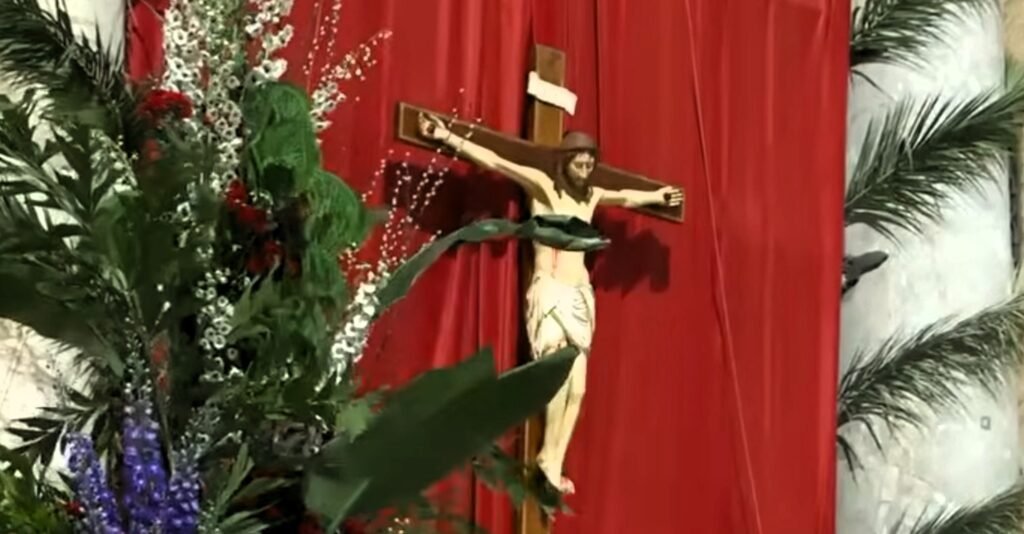
“URBI ET ORBI” MESSAGE
OF HIS HOLINESS POPE LEO XIV
EASTER 2026
Central Loggia of St Peter’s Basilica
Sunday, 5 April 2026Source
________________________________________
Brothers and sisters,
Christ is risen! Happy Easter!
For centuries, the Church has joyfully sung of the event that is the origin and foundation of her faith: “Yes, Christ my hope is arisen / Christ indeed from death is risen / Have mercy, victor King, ever reigning” (Easter Sequence).
Easter is the victory of life over death, of light over darkness, of love over hatred. It is a victory that came at a very high price: Christ, the Son of the living God (cf. Mt 16:16), had to die — and die on a cross — after suffering an unjust condemnation, being mocked and tortured, and shedding all his blood. As the true immolated Lamb, he took upon himself the sin of the world (cf. Jn 1:29; 1 Pet 1:18–19) and thus freed us all — and with us, all creation — from the dominion of evil.
But how was Jesus able to be victorious? What is the strength with which he defeated once and for all the ancient adversary, the prince of this world (cf. Jn 12:31)? What is the power with which he rose from the dead, not returning to his former life, but entering into eternal life and thus opening in his own flesh the passage from this world to the Father?
This strength, this power, is God himself for he is Love who creates and generates, Love who is faithful to the end and Love who forgives and redeems.
Christ, our “victorious King,” fought and won his battle through trusting abandonment to the Father’s will, to his plan of salvation (cf. Mt 26:42). Thus he walked the path of dialogue to the very end, not in words but in deeds: to find us who were lost, he became flesh; to free us who were slaves, he became a slave; to give life to us mortals, he allowed himself to be killed on the cross.
The power with which Christ rose is entirely nonviolent. It is like that of a grain of wheat which, having rotted in the earth, grows, breaks through the clods, sprouts, and becomes a golden ear of wheat. It is even more like that of a human heart which, wounded by an offense, rejects the instinct for revenge and, filled with compassion, prays for the one who has committed the offense.
Brothers and sisters, this is the true strength that brings peace to humanity, because it fosters respectful relationships at every level: among individuals, families, social groups, and nations. It does not seek private interests, but the common good; it does not seek to impose its own plan, but to help design and carry out a plan together with others.
Yes, Christ’s resurrection is the beginning of a new humanity; it is the entrance into the true promised land, where justice, freedom, and peace reign, where all recognize one another as brothers and sisters, children of the same Father who is Love, Life, and Light.
Brothers and sisters, through his resurrection, the Lord confronts us even more powerfully with the dramatic reality of our freedom. Before the empty tomb, we can be filled with hope and wonder, like the disciples, or with fear like the guards and the Pharisees, forced to resort to lies and subterfuge rather than acknowledge that the one who had been condemned is truly risen (cf. Mt 28:11–15)!
In the light of Easter, let us allow ourselves to be amazed by Christ! Let us allow our hearts to be transformed by his immense love for us! Let those who have weapons lay them down! Let those who have the power to unleash wars choose peace! Not a peace imposed by force, but through dialogue! Not with the desire to dominate others, but to encounter them!
We are growing accustomed to violence, resigning ourselves to it, and becoming indifferent. Indifferent to the deaths of thousands of people. Indifferent to the repercussions of hatred and division that conflicts sow. Indifferent to the economic and social consequences they produce, which we all feel. There is an ever-increasing “globalization of indifference,” to borrow an expression dear to Pope Francis, who one year ago from this loggia addressed his final words to the world, reminding us: “What a great thirst for death, for killing, we witness each day in the many conflicts raging in different parts of the world!” (Urbi et Orbi Message, 20 April 2025).
The cross of Christ always reminds us of the suffering and pain that surround death and the agony it entails. We are all afraid of death, and out of fear we turn away, preferring not to look. We cannot continue to be indifferent! And we cannot resign ourselves to evil! Saint Augustine teaches: “If you fear death, love the resurrection!” (Sermon 124, 4). Let us too love the resurrection, which reminds us that evil is not the last word, because it has been defeated by the Risen One.
He passed through death to give us life and peace: “I leave you peace; I give you my peace. Not as the world gives it, I give it to you” (Jn 14:27). The peace that Jesus gives us is not merely the silence of weapons, but the peace that touches and transforms the heart of each one of us! Let us allow ourselves to be transformed by the peace of Christ! Let us make heard the cry for peace that springs from our hearts! For this reason, I invite everyone to join me in a prayer vigil for peace that we will celebrate here in Saint Peter’s Basilica next Saturday, April 11.
On this day of celebration, let us abandon every desire for conflict, domination, and power, and implore the Lord to grant his peace to a world ravaged by wars and marked by a hatred and indifference that make us feel powerless in the face of evil. To the Lord we entrust all hearts that suffer and await the true peace that only he can give. Let us entrust ourselves to him and open our hearts to him! He is the only one who makes all things new (cf. Rev 21:5).
Happy Easter!
Source: https://www.vatican.va/content/leo-xiv/en/messages/urbi/documents/20260405-urbi-et-orbi-pasqua.html
Copyright © Dicastery for Communication – Libreria Editrice Vaticana
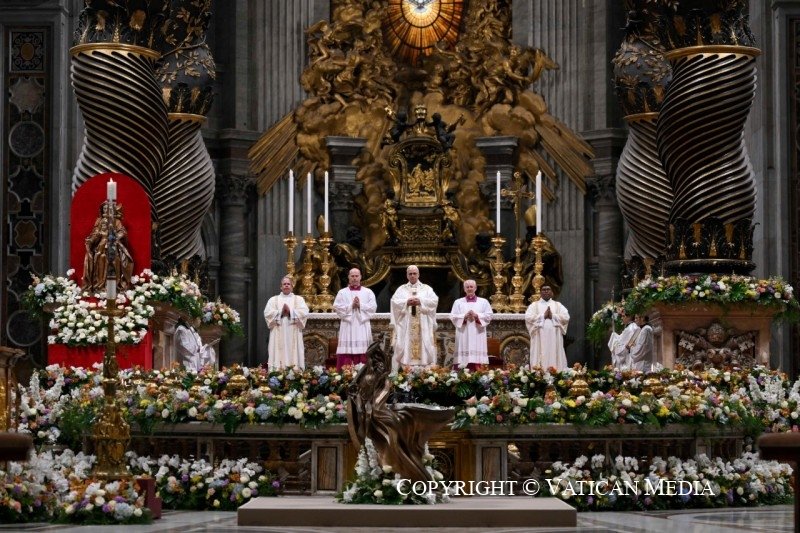
EASTER SUNDAY “RESURRECTION OF THE LORD”
EASTER VIGIL IN THE HOLY NIGHT
PAPAL MASS
HOMILY OF POPE LEO XIV
Saint Peter’s Basilica
Saturday, 4 April 2026
_______________________________________
“The sanctifying power of this night dispels wickedness, washes faults away, restores innocence to the fallen… drives out hatred, fosters concord and brings down the mighty” (Exsultet).
With these words at the beginning of this celebration, dear brothers and sisters, the deacon praised the light of the Risen Christ, symbolized by the Paschal Candle. From this single candle, we have all lit our own candles, and, each carrying a small flame drawn from the same fire, we have illuminated this great basilica. It is the sign of the Paschal light, which unites us in the Church as lights for the world. At the deacon’s announcement, we responded “Amen,” affirming our commitment to embrace this mission, and shortly we will repeat our “yes” by renewing our baptismal promises.
This, my dear friends, is a Vigil filled with light, the oldest in the Christian tradition, known as the “mother of all vigils.” In it we relive the victory of the Lord of life over death and the underworld. We do this, as part of one great celebration, after having journeyed in recent days through the mysteries of the Passion of the God who became for us “a man of sorrows” (Is 53:3), “despised and rejected by men” (ibid.), tortured and crucified.
Is there a greater act of charity? A more complete gift? The risen One is the same creator of the universe who, just as he brought us into existence out of nothing at the dawn of history, also gave his life for us on the Cross to show us his boundless love.
The first reading reminded us of this with the account of creation. In the beginning, God created the heavens and the earth (cf. Gen 1:1), bringing the cosmos out of chaos, harmony out of disorder and entrusting to us – made in his image and likeness – the task of being its stewards. Even when, through sin, humanity failed to live up to that plan, the Lord did not abandon us, but revealed his merciful face to us in an even more surprising way – through forgiveness.
The “holy mystery of this night,” then, has its roots even in the place where humanity’s first failure took place, and extends across the centuries as a path of reconciliation and grace.
Through the sacred texts we have heard, the liturgy has shown us some of the stages of this journey. It reminded us how God stopped Abraham’s hand as he was about to sacrifice his son Isaac, to show us that he does not desire our death, but rather that we dedicate ourselves to being, in his hands, living members of the lineage of those who are saved (cf. Gen 22:11–12, 15–18). In the same way, the liturgy invited us to reflect on how the Lord freed the Israelites from slavery in Egypt, transforming the sea – a place of death and an insurmountable obstacle – into the gateway to a new life of freedom. The same message echoed in the words of the prophets, who praised God as a bridegroom who calls and gathers (cf. Is 54:5–7), a spring that quenches thirst, water that brings forth fruit (cf. Is 55:1,10), a light that shows the way to peace (cf. Bar 3:14) and Spirit who transforms and renews the heart (cf. Ez 36:26).
In all of these moments in the history of salvation, we have seen how God responds to the hardness of sin – which divides and kills – with the power of love, which unites and restores life. We have heard the narrative interwoven with psalms and prayers, reminding us that, through Christ’s Paschal Mystery, “we were buried with him by baptism into death… we too might walk in newness of life… dead to sin and alive to God in Christ Jesus” (Rom 6:4,11); we are therefore consecrated in Baptism to the Father’s love, united in the communion of saints and made, by grace, living stones for the building up of his Kingdom (cf. 1 Pet 2:4–5).
In this light, let us reflect on the story of the Resurrection, which we heard in the Gospel according to Matthew. On Easter morning, the women, overcoming their grief and fear, set out on their journey. They wanted to go to Jesus’ tomb. They expected to find it sealed, with a large stone at the entrance and soldiers standing guard. This is what sin is: a heavy barrier that closes us off and separates us from God, seeking to kill his words of hope within us. Mary Magdalene and the other Mary, however, did not let themselves be intimidated. They went to the tomb and, thanks to their faith and love, became the first witnesses of the Resurrection. In the earthquake and in the angel sitting on the overturned stone, they saw the power of God’s love, stronger than any force of evil, capable of “driving out hatred” and “bringing down the mighty.” Man can kill the body, but the life of the God of love is eternal life, which transcends death and which no tomb can imprison. Thus the Crucified One reigned from the cross, the angel sat upon the stone, and Jesus appeared to them alive, saying, “Greetings!” (Mt 28:9).
This, my dear friends, is also our message to the world today. The encounter to which we want to bear witness – through the words of faith and the works of charity – we do so by “singing” with our lives the “Alleluia” that we proclaim with our lips (cf. Saint Augustine, Sermon 256, 1). Just as the women rushed to tell the disciples, we too should desire to set out tonight from this Basilica to bring to all the good news that Jesus has risen and that having risen with him, through his power, we too can give life to a new world of peace and unity as “a multitude of people and yet […] a single person, for although there are many Christians, Christ is one” (Saint Augustine, Commentaries on the Psalms, 127:3).
Our brothers and sisters gathered here, who come from various parts of the world and are about to receive Baptism, will dedicate themselves to this mission. After the long journey of the catechumenate, today they are reborn in Christ to become new creatures (cf. 2 Cor 5:17) and witnesses to the Gospel. To them, and to all of us, let us repeat what Saint Augustine said to the Christians of his time: “Proclaim Christ, sow…, spread everywhere what you have conceived in your heart” (Sermon 116, 23–24).
Sisters and brothers, even today there are tombs to be opened, and often the stones sealing them are so heavy and so closely guarded that they seem to be immovable. Some weigh heavily on the human heart, such as mistrust, fear, selfishness and resentment; others, stemming from these inner struggles, sever the bonds between us through war, injustice and the isolation of peoples and nations. Let us not allow ourselves to be paralyzed by them! Over the centuries, many men and women, with God’s help, have rolled them away — perhaps with great effort, sometimes at the cost of their lives — but with good fruits that we still benefit from today. They are not unattainable figures, but people like us who, strengthened by the grace of the Risen One, in charity and truth, had the courage to speak, as the Apostle Peter says, the “very words of God” (1 Pet 4:11) and to act “with the strength that God supplies, so that God may be glorified” (ibid.).
Let us be inspired by their example, and on this Holy Night let us make their commitment our own, so that the Easter gifts of harmony and peace may grow and flourish everywhere and always throughout the world.
Copyright © Dicastery for Communication – Libreria Editrice Vaticana
Source: https://www.vatican.va/content/leo-xiv/en/homilies/2026/documents/20260404-veglia-pasquale.html
Stay updated: subscribe by email for free TO OUR NEW WEBSITE catholicsstrivingforholiness.org (PUT YOUR EMAIL IN THE SUBSCRIBE WIDGET).
If you need some resources regarding a particular topic, feel free to use the search WIDGET which has access to thousands of posts, categories and tags on Catholic spirituality.
Cordially inviting you as well to follow www.fb.com/Catholicsstrivingforholiness. and share our posts to help more people in their Christian faith and life.
Thanks and God bless you and your loved ones! Fr. Rolly Arjonillo.